Escaping ECS

ECS, Early Christmas Syndrome, is alive and well and even earlier this year, it seems. I reported last month on the irritating arrival of Christmas adverts in October and November. Christmas lights have been blazing in our local towns during November. Perhaps it would be better to just call them ‘winter lights’ and hang them from November to the end of January to cheer the winter gloom. As soon as December got a foot in the door, holly wreaths and Christmas trees appeared in our street, and Christmas cards started dropping on to the mat. Which made me think – would you start celebrating your birthday three weeks before the event? Surely there must be a certain amount of tinsel fatigue by the 25th?

On what I later discovered was called Cyber Monday, when Amazon’s robots were working overtime to deal with gift orders, we headed up to the Lakes to look at nature’s December decorations. Apart from some glorious beeches which are holding on to their leaves, most of the trees are bare now, but that makes the views better. We did our favourite walk, the round from Skelwith Bridge to Little Langdale, then over to Elterwater and back to Skelwith. It starts and finishes at the lovely Chesters by the River Café and you have the option of two pubs on the way – the Three Shires in Little Langdale, and the Britannia Inn in Elterwater. We often call it the ‘visitors’ walk’ because it’s where we take friends and visitors to show them the Lake District in a nutshell – a lovely café and pubs, a lake (Elterwater), a tarn (Little Langdale Tarn), the quaint Slater Bridge in Little Langdale, a waterfall (Colwith Force) and the amazing Cathedral Cavern, a quarried out cave complete with a window. This cavern is a secret first shown to me by the Lakeland Voices singing group, whose leader David Burbidge introduced us to its wonderful acoustic. It makes any ordinary singer sound like an opera diva. Go and try it out if you can find it!

SONY DSC

Slater Bridge

So when I walk this way, it’s like walking with friends, as I remember this is where I had a picnic with M and K, this is where F and I were lucky enough to see the Morris Dancers, and so on. I said hello to a lot of you on Monday! But I’ll still send Christmas cards … later …

Noticing November

November is a neglected month.  It starts with leftover Hallowe’en pumpkins, has some brief excitement with popping fireworks, then pauses for Remembrance.  It never quite picks up after that. All the while, of course, Christmas is already barging in, making its commercial presence felt in shops and on television.  On the first Sunday of November the lengthy ad breaks in ‘Downton Abbey’ were punctuated with suggestions that a new sofa or dining room suite would be ‘great for Christmas’.  It’s as if we want to wish November away.

The other thing about November, of course, is the dark evenings.  When I was working in teaching, we always returned from the October half term break singularly unrefreshed.  Jetlagged by the clock change, we moaned about the darkness and rain, and then got on with the serious business of getting students through the exam hurdle before the Christmas lights and festivities.  Drowning in marking and reports, I hardly noticed the month.

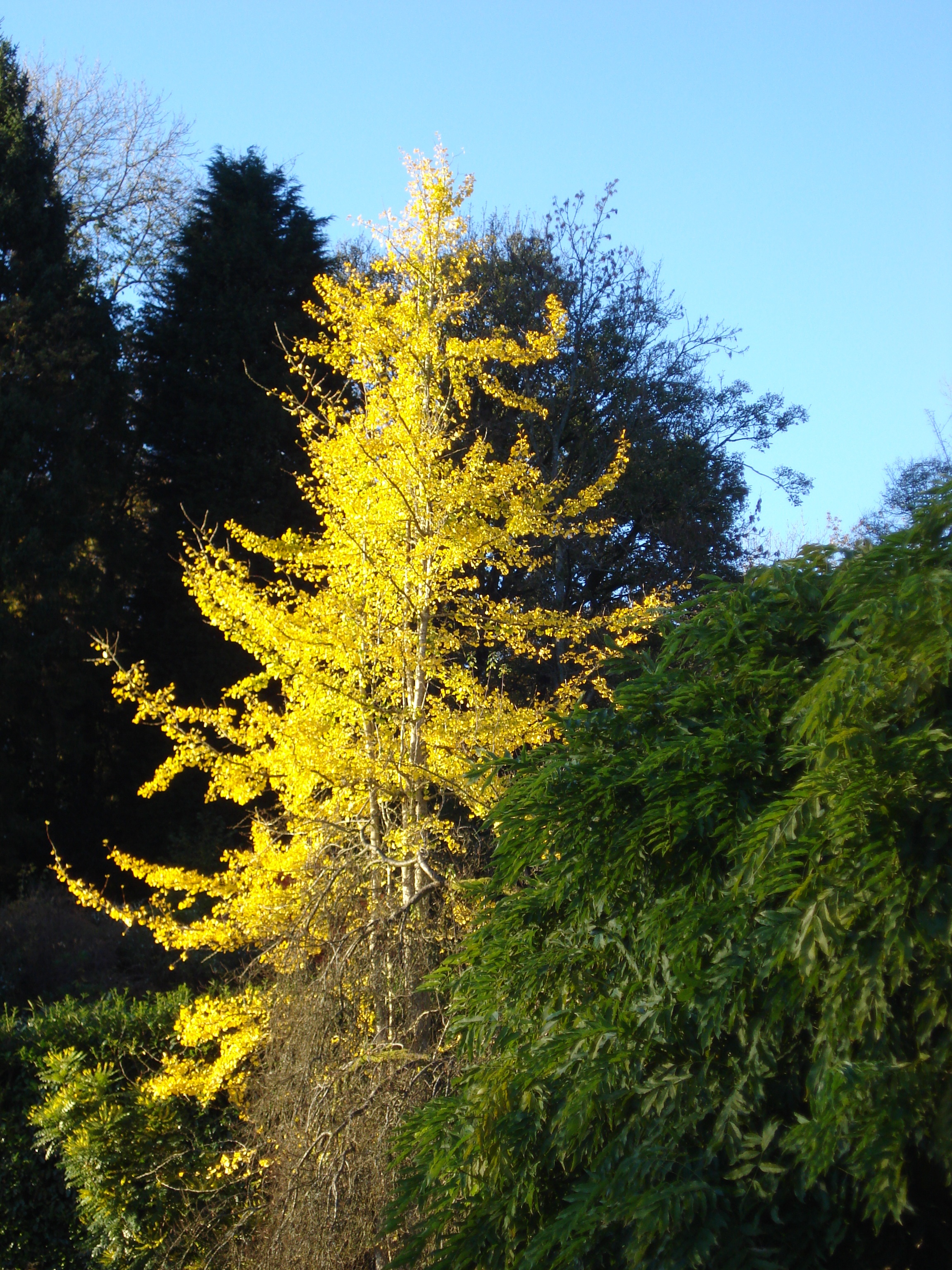
But since my retirement I’ve discovered November.  In between the waves of Atlantic depressions bringing wind and rain, there can be sparkling days to enjoy.  The main half term crowds have gone, but there were still plenty people out enjoying the Lake District yesterday.  We walked round Rydal and Grasmere in perfect conditions; the November foliage glowed in the sun and the sheep might even have thought it was summer.

DSC04787

I intend to savour the rest of the month and put Christmas to the back of my mind.   Christmas is for December.  The second half of December, to be precise.

DSC04793DSC04791

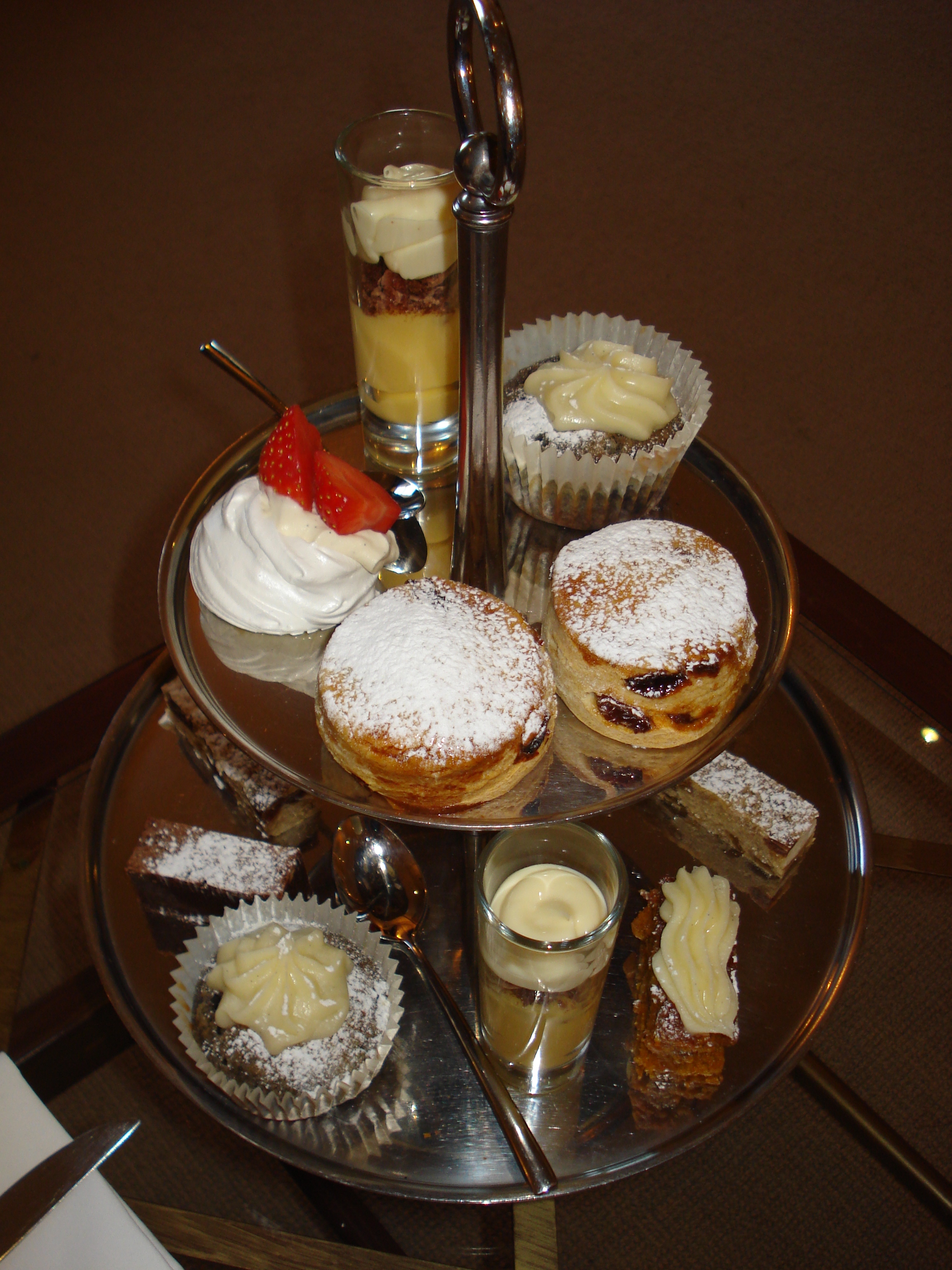
Continuing a tradition of cake pictures, my final photos are of our champagne afternoon tea at The Samling, between Ambleside and Windermere (http://www.thesamlinghotel.co.uk/).  We’d been given a gift voucher for this and yesterday was the perfect day to use it.

DSC04794

DSC04796We left after sunset.  Through the trees we saw the Langdale Pikes silhouetted behind the silver of Windermere. Venus shone brightly to the south-west, and two deer stood still on the lawn in the twilight, watching our progress down the very steep driveway.  It was a special November moment.

Changing the backdrop

Life changed for a week.  Like the inhabitants of Cranford, we were all agog with gossip:

‘Have you heard they’re staying at the Sun Inn?’

‘They say filming starts on Monday…’

‘And it’s one of the ‘Downton Abbey’ stars….’

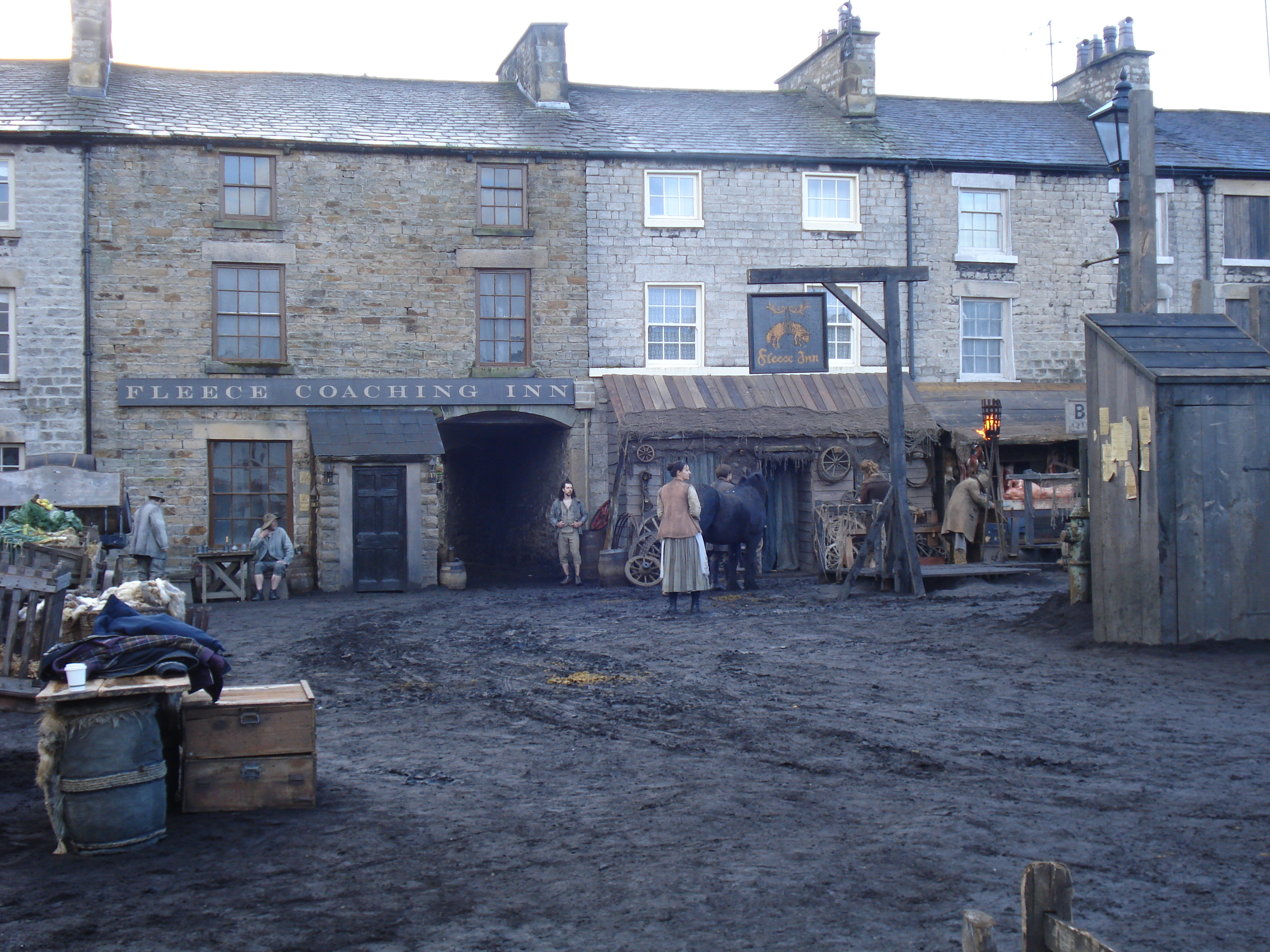
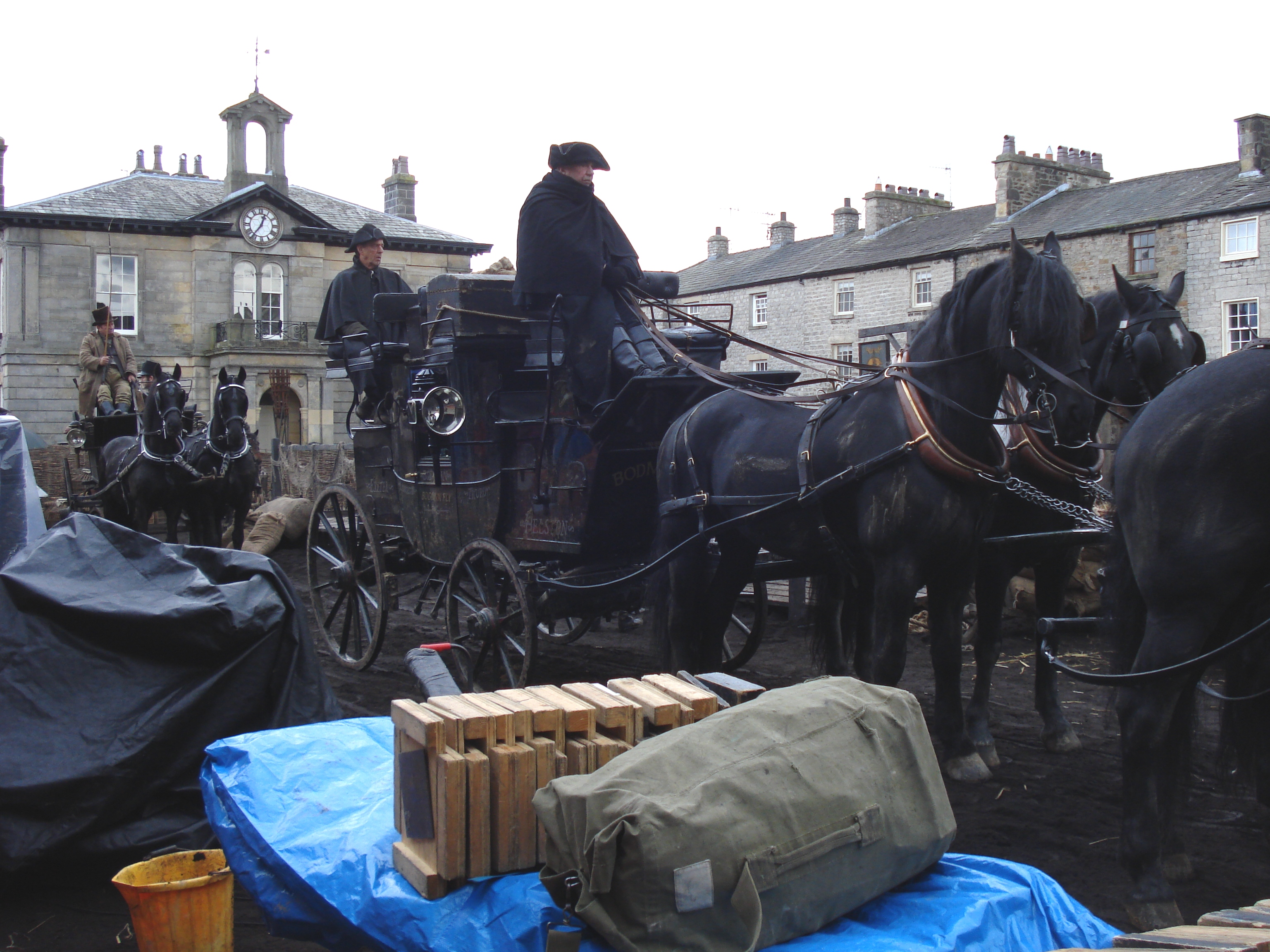
Our town, set between the Yorkshire Dales and the Lake District, was taken back to 1820s Cornwall for the filming of scenes for the BBC’s ‘Jamaica Inn’, to be presented as a three-part serial sometime next year.   The buildings are apparently the right colour for Launceston.  Each day brought intriguing new developments.  Firstly, the square was filled with piles of artefacts in shades of dull brown – market stalls, barrels of rum, brooms, braziers, baskets, carts and coffins.

preparationsEmily's

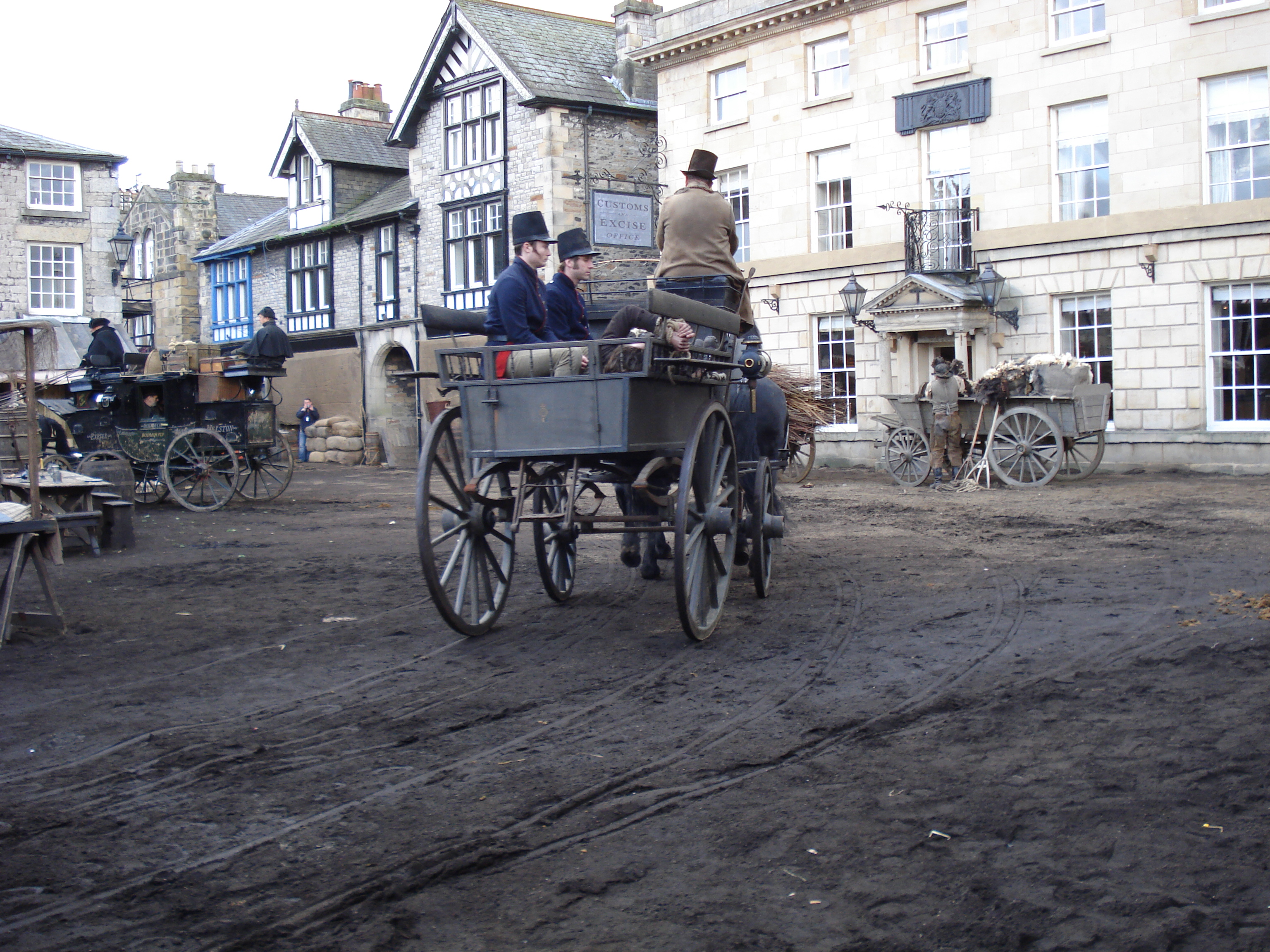
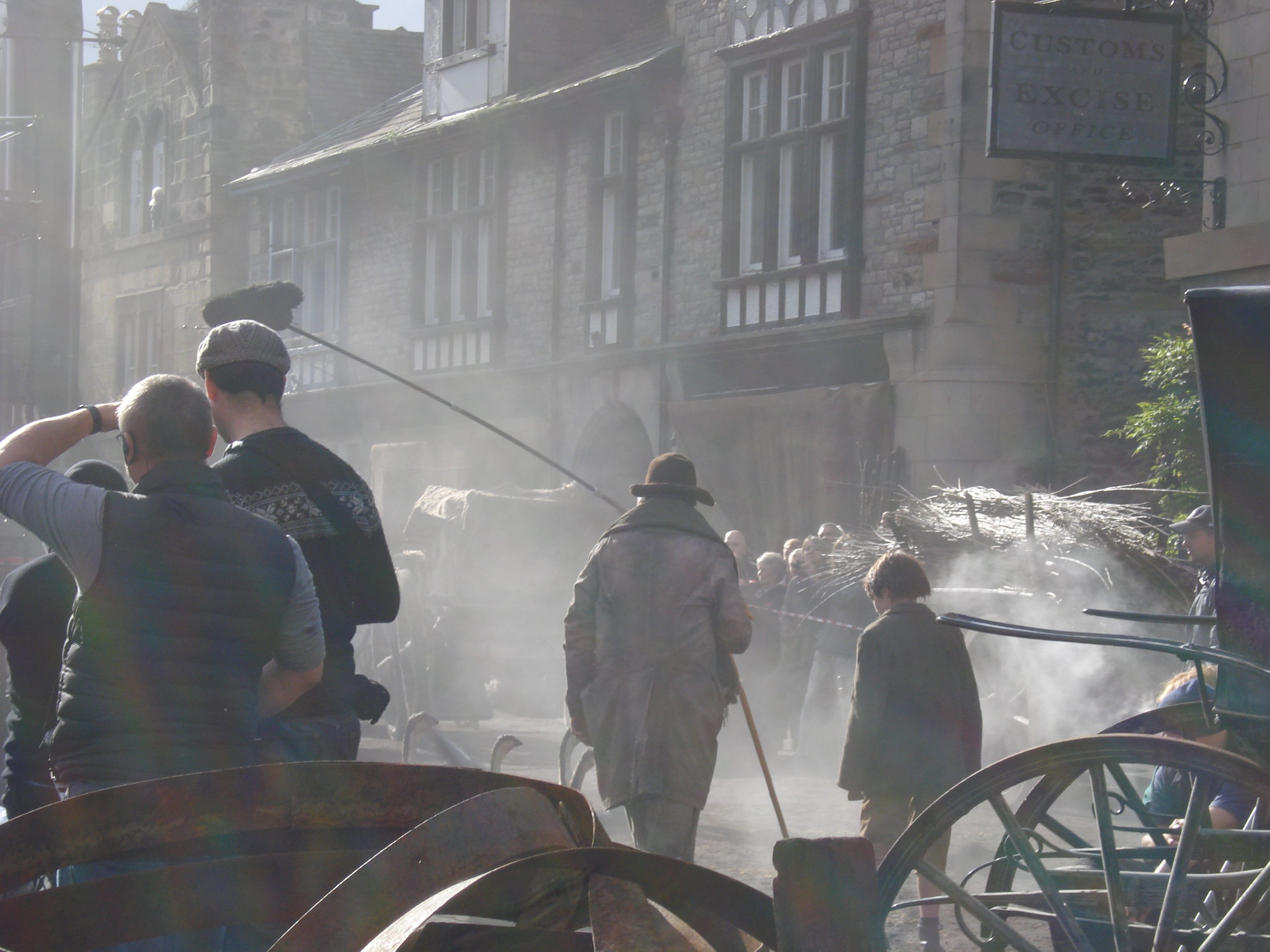
Two days later they were spreading rich dark earth over the lines for the parking bays, building new frontages in wood for the shops and cafés on the south side of the square and erecting a neat little wooden shed to hide the ‘Pay and Display’ machine. The estate agent became the Fleece Inn, and the local hotel became the Customs and Excise Office.

Fleece

DSC04732

Like many in the town, I couldn’t keep away.  On Monday they brought on horses and carriages, and there was a glimpse of Jessica Brown Findlay, reincarnated after her death as Lady Sybil in ‘Downton Abbey’, passing in the Bodmin Fly.

DSC04729

Then on came the actors, smoke machines and rain machines, more horses and some geese.  Fifty local extras stood around in the cold waiting for their moment – as did the main actors, of course.  The horses were equally patient.

waiting

The crowd watched and chatted and wondered.

‘All this for fifteen minutes of film, I’ve heard.’

‘Amazing.  A once in a lifetime event for us, living on a film set.’

‘Is that her?  Lady Sybil?’

‘Fancy that, in our town.’

‘Wonderful earth, that.  Could do with some for my garden.’

More community spirit was engendered than on any other day of the year.  In a similar way, I posted a picture of the set on my Facebook page and found it was one of the top posts of the year for ‘likes’.  I began to wonder about this.  Is it because it takes us out of our reality, as any piece of fiction does?  Is it because of the draw of ‘celebrity’?  Do we want to be able to travel back in time?  Do we want to be ‘in a story’?  Do we just enjoy those moments of incongruity, such as the innkeeper on his smartphone between takes?  Whatever it is for each individual, it led me to reflect on the great power of stories in our lives.   Which reminds me I really ought to be getting on with my first short story assignment for my OU course.  But perhaps I’ll go down and check on the filming first.

smoke

customs

The Food of Writers

On Sunday I headed off to spend the day with some people I’ve met ‘in the computer’. We know each other quite well, but before Sunday we’d never met face to face. We’re a group of six originally from the Facebook group for the Open University’s ‘Start Writing Fiction’ short course in 2011. We then set up our own online forum to exchange writing ideas and critique each other’s work during A215, the OU’s next Creative Writing course. We’ve supported each other through short fiction, poetry and life writing, each beginning to find her own direction. We’ve had humour and pathos, family stories, historical fiction, travel writing, free verse, sonnets and much more. And we’ve enjoyed it so much that we’ve all signed up for A363, Advanced Creative Writing, which kicks off this week.

I think it was Ruby from Wiltshire who first suggested a ‘real’ meeting. Our locations range from Essex to Cumbria, so all roads led to Birmingham, where Giselle kindly offered us hospitality. We had plans to workshop some new writing, perhaps read a short play or produce an unconventional poem. Then gradually, insidiously, the menu planning took over….

I quote from our literary forum:

‘Should it be coffee and walnut cupcakes, lemon or almond sponge, or a chocolate cake? I may go the chocolate route, although it seems less creative in baking terms.’

‘Perhaps you could bring some bread. Is there a nice artisan baker near you?’

‘Brie and Camembert would be fine, and maybe a Cheddar or Double Gloucester to go with Lauren’s green tomato chutney.’

‘I am doing a sour cream and chocolate cake and am still um-ing and ah-ing about converting it into cupcakes.’

‘Dessert is extremely important to me and I am inclined to plan it over a week in advance.’

‘You have a Tassimo machine? Oh wow!’

‘Caffeine has a long history of helping the development of creative writing.’

‘We made a fab Tiramisu last night with some unexpected twists.’

‘Caffeine and sugar tend to give one a boost for writing.’

DSC04694

So what was it like, meeting for real? I’d say that meeting and sharing our work online meant that we really did know each other quite well. The surprises came in things like accent, the timbre of the voice, or our heights. Some of us were so much smaller than we expected. In fact, we didn’t pick out Viola for ages on the station platform, because we expected her to be very tall. It’s a bit like imagining a character in a book and then finding they look different in the film version.

Oh, and after the unexpected bonus of a long, al fresco lunch on a warm October day, we did settle down to some writing chat and air our ideas about writing the first assignment, due on October 31st.

I wonder who’s going to write about food.
Singing and writing the blues

I’ve just attended a choral workshop on Will Todd’s ‘Mass in Blue’.  I’ve sung the words of the mass with various choirs over the years;  some masses have been gentle, some loud, some predictable and some surprising.  This was surprising.  Will’s website describes it as ‘an upbeat setting of the Latin mass for SATB choir, soprano solo and jazz trio or ensemble’.  Ralph Woodward, who led the workshop with Will at the piano, soon had us swinging enthusiastically to the beat even if our sight-reading wasn’t always up to hitting the right notes.

What was most interesting about the day, though, was having Will Todd give a short talk on his work.  He explained how he was classically trained but always wanted to write jazz, and that he was initially dissuaded from doing so by his more traditional university teachers.  I don’t know much about jazz, and indeed I would put it low down on my list of preferred musical genres, but I began to change my mind in the course of this day.  He explained how jazz has to do with improvisation.  When writing a piece in the classical manner, you may have things planned out more and know what’s going to happen.  But in jazz there will be surprises.  I began to think of the analogy with writing; some writers plan in great detail, others ‘freewrite’ and see where their intuition takes them.  Others do a mixture of both, and I think I’m probably in that camp.

I liked Will’s thoughts on the editing process; ultimately the most important thing is to recognise the difference between the diamonds and the dross and have the courage to throw away the latter, edit and redraft.  He explained how he rewrote the entire Mass in Blue, keeping in one special phrase from the Benedictus, adding ‘when it’s the right thing, it’s easy to finish’.

His final advice?  Make sure you create with the whole you.

More on Will Todd at http://willtodd.com/massinblue.php


Once upon a time … two weddings in fairytale Germany

Germany isn’t normally on the tourist trail for the British, but I’ve long had connections with the country through my career teaching modern languages and have always had a good time there, so I like to spread the word.  This time we had a special reason to go, as we’d been invited to a wedding in a castle near Marburg.  Marburg?  I know, it’s not exactly well known here, but it’s the seat of the oldest Protestant-founded university in the world and home of the brothers Grimm, who collected many of their fairytales in the area.  The half-timbered houses of the old town cling to a steep hillside, where narrow cobbled streets wind their way steeply up to the castle with its Rapunzel towers, steep roofs and rows of tiny attic windows.  It was still warm enough in September for cafés to have tables outside; they serve international cuisine as well as German fare.  We were there on a Sunday, and it was pleasantly uncrowded, but there must be quite a buzz when the town’s 23,000 students are there in term time.

Cinderella's slipper on the 'Grimm trail' below Marburg castle.

Cinderella’s slipper on the ‘Grimm trail’ below Marburg castle. 

Marburg is right in the centre of Germany, and we flew from Manchester to Hanover.  Frankfurt would have done just as well, but we had friends in Hanover we wanted to see.  We went through the airport and as far as the plane at Manchester with very little true customer service; from the self-check-in at Flybe to the self-check-out at W H Smith it was bleep and scan all the way, but the lady at the Duty Free did wish me a nice time when she discovered I was going to a wedding.

The wedding was in the village of Rauischholzhausen.  Germany is full of little villages like this with quiet streets, criss-cross wooden fences round neat gardens and half-timbered houses.  This one was dominated by the castle, a large country house and estate owned by the University of Gießen as a conference centre and available for hire as a wedding venue.

DSC04624

Our hosts had arranged accommodation for us in the Hotel zum Stern.  It proved a great find  – spotlessly clean with large rooms and, in contrast to Manchester Airport, excellent service.

German weddings rely on guest input.  You’re invited, and you join in.  This means providing a page for a guest book for the couple with photos from the past or advice for the future, putting on a sketch or organising a game. Many people had brought home-made cakes with them, and there was an afternoon cake buffet after the wedding service.  During the break before the evening meal  the couple had a photo shoot and photos were also taken of the guests for a calendar  –  we were taken in groups according to the month of our birthday.

If money is specified as the couple’s preferred gift, then you don’t just put it unimaginatively into an envelope.  There are whole websites and books devoted to money origami, and we saw money folded into many forms, the best being a beach scene with 20 Euro notes made into deck chairs and 10 Euro notes as little fish.  The couple spent the day after the wedding ironing out all the creases, which gave a new slant to the term ‘money laundering’.

Our second wedding came a few days later at the VW plant in Wolfsburg, where we visited the museum and did a factory tour.  Such was the size of the plant, which covers ‘an area the size of Gibraltar’, that we didn’t need to move from the bus with big windows that drove us round the grounds and along the factory floor.  Workers in white overalls stood on an immaculate production line wielding tools and machinery, and remarkably human looking robots lifted their clever arms to glue and install windscreens and put on the wheels.  ‘And now we have a wedding,’ our guide noted with satisfaction as we neared the end.  ‘The top of the cars are wedded to the bottom.’  We think he meant welded, but we quite liked the notion of another marriage.  It rounded off the visit nicely.

Just a few cakes

Just a few cakes