• About Christine Cochrane
  • Blogs
  • Home Page
  • Links
  • Publications
  • Reviews

Harping On

~ A Writing Journey

Harping On

Category Archives: Writing News

School Memories

28 Wednesday Aug 2024

Posted by Iain C in Writing News

≈ 2 Comments

This entry is probably far too long to be considered a Blog Post.  However, ignoring that possible breach of on-line etiquette, and because I have just renewed Christine’s web-site domain, here is her commentary on her memories of Farnell Primary School that she wrote in April 2011. I’m pretty sure that she didn’t blog this earlier . . .

The genesis of this essay was a proposal (by a person or persons now forgotten) to create a written record of the history of Farnell, which is a hamlet some six or seven miles west of Montrose in the Scottish County of Angus.  For this, there was a meeting in Farnell of interested/invited parties to discuss the project, out of which came Christine’s essay.

And what of the whole project?  As far as I know, nothing more was heard.  However, I think that Chrissy’s account is interesting in itself, but also as a historical record of a time before Ofsted, Inset Days, and Internet Instruction.

Just a little more background: Christine started her Primary Education in Banchory, but, when her father moved Parish to Farnell in 1959, she began her attendance in the small village school, a few minutes’ walk from the Manse. 

This what she wrote:

I attended Farnell School from 1959 to 1964.  The “dominie” at the time was Mr Duncan McNicol, who was assisted by Miss Evelyn Simpson, who travelled out to the school every day on the bus from Montrose.  I arrived into Miss Simpson’s Primary 3 in 1959 and found myself in a classroom which also contained Primary 1 and Primary 2.  I then moved in 1960 through the connecting door into Mr McNicol’s room, where I remained until my primary education was completed.

Farnell was a very different world for me, as I had come from a big primary school with over 30 in my class, and here there were about 40 – 50 children in the entire school.

At that time the school consisted of two buildings.  There was the original old school, now House of Farnell, which contained the dining hall, kitchen and drill hall.  A new two-classroom school had been built beside it.  The entrance hall of this building contained pegs, sinks and carbolic soap. The toilet block was behind the new school building and had no heating whatsoever, so that in winter the toilets invariably froze at times.  The “missy”, as Miss Simpson was referred to, had her own toilet in the old school block, and Mr McNicol went home!  Behind the toilet block there was a triangle of grass which we were allowed on only in the summer months.  We had a large tarmac playground area round the two school buildings where we played games and made “slides” when it froze in winter.  At the start of the day, at the morning break and at lunch time, Mr McNicol would stand at the door and ring a hand bell, waiting for us to line up in our classes.  The new school was heated by a stove, and the milk bottles were often put beside it in winter so that the ice could thaw. 

My class contained Rosemary Arthur, Margaret Tye, Jean Gibb, Brian Youngson and Malcom Ferguson. Each class contained about 6 pupils, and there were many brothers and sisters among us.  We always sat in the order in which we had passed the last set of exams, with the person top of the class at the back.  What was interesting was that, although we identified with a class within the building, these distinctions disappeared to a great extent in the playground – girls and boys would split for particular games, the older ones would look after the younger ones, and sometimes we would organise games that involved everyone; it had a true family atmosphere.  That’s not to say there was no bullying, or that we didn’t fall out with each other at times, but in the main it was a happy place to be. 

There were times when we were taught together – often first thing in the morning Mr McNicol would decide to teach a topic of interest to all.  One I remember is that he turned the tap on and invited us to consider where that water had come from and the long journey it had made to get there!  We sang together, usually under the direction of a radio broadcast like “Singing Together”, and would blast out “Men of Harlech” and “Heart of Oak”.  And sometimes Mr McNicol would play the piano for us to sing along, usually a hymn to start the day.  While we would sing with gusto in a group, it proved rather harder to get us to produce solos.  Each year we were invited to sing for the Burns Society Award in the Singing of Scottish Songs; one by one we were invited out to the piano to see what we could do, and the awards were eventually made to those who could keep in tune and produce more than a squeak!  There was also an award from the Burns Society for the reciting of Scottish verse.

Tuesdays and Thursdays were Handwork days, and in the latter part of the afternoon we were divided into boys’ and girls’ groups, with the girls going into Miss Simpson’s room to do knitting and sewing.  There was a clear progression in the difficulty of the knitting and sewing; in Primary Three I knitted a scarf which did not capture my imagination.  In Primary Seven we were expected to produce a pair of socks, including the skills of turning the heel and grafting the toe.  The Primary Three sewing project was a lap bag in which to keep our sewing and knitting for the remainder of our time at the school, and in Primary Seven we made a cooking apron to take to secondary school with us.  The boys’ handwork projects involved work with cane, making trays etc, and I think the girls always considered this more exciting.  Before Christmas, we always produced a calendar with a picture of our choice and a “calendar tab” stuck on the bottom, and in early December we started work on making paper chains and lanterns to decorate the classrooms for Christmas.  The decorations were the same every year and were never recycled.

Friday afternoon was Art time, which we all enjoyed; it seemed an appropriate relaxation before the weekend, not that school life in those days was in any way stressful.  The subjects were often linked to the seasons, or indeed the news.  I don’t only remember the day President Kennedy was shot; I remember painting Kennedy’s funeral.  Once a year we entered the Brooke Bond Art Competition and my copy of “The Secret Garden” was bought from winning a book token for this.

Teaching several classes in one room is an organisational challenge for the teacher but is ultimately of great benefit for the pupils.   The fact that we did all the above things across the age groups increased a kind of family atmosphere.  There were other advantages to having three or four classes together.  When we had finished the work set for us, we were invited to read a book or “Knowledge” magazine on our own, but for me this was also a time for listening in to what another class might be doing; in this way we got an insight into very grown up things like vulgar fractions before it was our time to learn the topic officially, and I think absorbing this intentionally or subliminally helped our education greatly.  I remember an atmosphere of order and industry, and a great deal being quietly achieved.  There was, of course, the deterrent of the strap for any misdemeanour.

The “three Rs” featured large – each day we worked from a reading book, learned some key words from “The Essential Spelling List” and had exercises from the “Sure Foundation” arithmetic book series.  We graduated from writing with a pencil to dip-and-scratch ink pens; there were no biros or felt tips!  A pencil, ruler, rubber and pen were kept in our “pencil packets”, stiff cardboard envelopes which were kept in empty National Dried Milk tins on the window sills at the back of each class.  History, Geography and Nature Study were taught by copying a note down from the board, but I do not remember the topics being actively discussed. The day started with recitation of our tables – we would start one day with the 2-times table, and move on to the next one the next day, and when we had done the 12-times table we went back to 2, which was always done with great relief and some speed!  The 10-times table was a particular favourite.  We then moved through the weight, capacity and length tables before starting on the day’s work. 

Sometimes there were special treats for us!  The district nurse once visited us because she had been to Africa and had slides to show.  And about once a month we had a filmstrip, usually illustrating the lives of famous Britons like Elizabeth Fry or David Livingstone.  For these we were escorted over to the dining room in the old school building.  The films, although black and white, were considered a real treat.

Sport and games were also very different from what we would have today.  Mr McNicol took us over to the “drill hall” in the old school building and proceeded to lead us through a series of physical exercises.  There was no sports kit apart from gym shoes (“jimmies”) and Mr McNicol himself led the proceedings still wearing his suit and normal leather shoes. We seemed to do a lot with beanbags, often in team games, and sometimes Mr McNicol sat back and let the radio programme “Music and Movement” do the work.  In the summer, Primaries Four to Seven always played  rounders together.  Mr McNicol marked out the bases in chalk on the playground, and two people in Primary Seven were invited to pick the teams.  This meant that if you could run fast and were older you would be picked first, and if you were in Primary Four and not at all athletic you would be standing there feeling very sorry for yourself at the end.  We used a tennis racquet and tennis ball for the rounders.  I didn’t enjoy it in Primary Four, but by Primary Seven I had speeded up and improved my catching and was picked first rather than last to join the teams. 

In the summer we had a sports day and school picnic – sometimes we went away for this, but it could also be in a local field, eg at Farnell Mains.  There were sack races, egg-and-spoon races and dressing-up races.

Trips and outings had to be saved for!  Occasionally there was a trip to Edinburgh, and for this we took along a shilling a week which was marked up on a card until we had the pound necessary to participate.  It was a lot of money in those days.  I remember going to Edinburgh and visiting the Zoo, Holyrood House and the Castle all in one day, finishing up with fish and chips in a hotel on Princes Street before we got the train back to Montrose. 

Fiona Hogg, the nurse who had come with the slides of Africa, also visited once a month to check us over – nails and hair were thoroughly examined in the entrance hall, which always smelled of carbolic soap.  The minister came once a month to give a short service and address.  In addition to the school teaching staff, we also had Mrs Macintosh cleaning for us and Mrs Arthur serving the dinners.

One thing that was interesting for me was the bilingual nature of the school in which I had arrived.  I had come from a school where Scottish dialect was not spoken, but here all the children spoke in the vernacular and asked me on my first day if I was “English”!  Scottish dialect was spoken in the playground, but in the classroom the children automatically switched to “proper” English.  In an attempt to disprove my classmates’ theory of my origin, I adopted the dialect as quickly as I could – I don’t remember making a conscious effort, just slipping into it in the way that children easily do.  Perhaps this early experience of a “foreign” tongue helped me to become a linguist in later life.

The playground was the focus of many games – we did not sit about, but were very organised in entertaining ourselves.  If a particular game was proposed, someone would walk round shouting “join on” until you had enough people.  A particular favourite was “bully horny” – I have never been able to find a reference to this game elsewhere, and its name always intrigued me, but it was basically chain-tig.  Another was called “ten a foxy”, and I am not sure of the spelling!  One person was the fox, and the others had to cross the playground without being nabbed by him.  If the fox caught you, you had to get away before he had counted to ten.  There was also “grandfather’s footsteps”, which I think is well known.  The girls were left in no doubt as to where they stood in the scheme of things – any “join on for bully horny” chorus was always followed by the words “lassies ahint”.  The girls of course also did skipping, with rhymes such as “I am a girl guide dressed in blue, see all the actions I can do”.  Winter brought a frozen playground and the eagerly anticipated “slidies”.  I went home for lunch, but, on the days when there was a “slidy”, rushed back to school as quickly as possible.  You could do a plain slide, a “wee manny” (which meant crouching down at the end) or “turning the key in the lock” (which involved turning round 180 degrees as you travelled).

Once a year we were invited to collect rosehips from the hedgerows; these were sent off to make rose hip syrup.  As there were not enough rosehip bushes around Farnell to yield enough for everyone, this involved persuading your parents to take a drive out somewhere to find some!  We were rewarded with 3d a pound, and if you collected ten pounds of rosehips you got a Rose Hip Collector’s Badge.  There was a poster on the classroom wall of an empty bottle which was gradually shaded in as the school’s rosehip tally went up. 

In our final year at school we sat the eleven plus and departed to various secondary schools in the area.  I went on to Montrose Academy, but the majority went to Brechin High School or to Friockheim, which was then termed a junior secondary.  The exam involved an essay, arithmetic and an IQ paper, and I remember the day when Mr McNicol proudly announced to our class that we had all been accepted for the course which we wanted to do.  I left proud of the primary education I had at Farnell.  It has stood me in very good stead, as have the skills of mixing with people of different ages.  And I still know how many chains there are in a furlong and how many yards in a mile. 

From Glasgow to Germany – Ships that Pass

30 Tuesday Jul 2019

Posted by Iain C in Writing News

≈ 3 Comments

I found this post, dated October 2016, under ‘Drafts’ on Harping On.  I don’t know why Christine didn’t post it at the time, but I see no reason why I should not bring it into the light of the internet.  Besides, the catalyst for Ships that Pass was my paternal grandmother’s diaries written over a few weeks in 1905.  Christine was keen to write in the ‘Show, not Tell’ manner, allowing, or, rather, requiring the reader to think behind the words.  Although many aspects of the story were invented by Christine, the lightly-veiled, underlying tragedy had a solid basis in fact.  Anyway, this is Christine’s Post . . .

I am currently putting the finishing touches to the German version of my story ‘Ships that Pass’, which will appear before the end of the year in an anthology published by Edition Narrenflug. Once again I’m very grateful to Karin Braun and Gabriele Haefs for inviting me to contribute and for the interesting work-shopping which we’ve done on the German version.  Thank you!

The English version of the story appears in my collection ‘Shifting Sands: Tales of Transience and Transformation.’

dsc00769

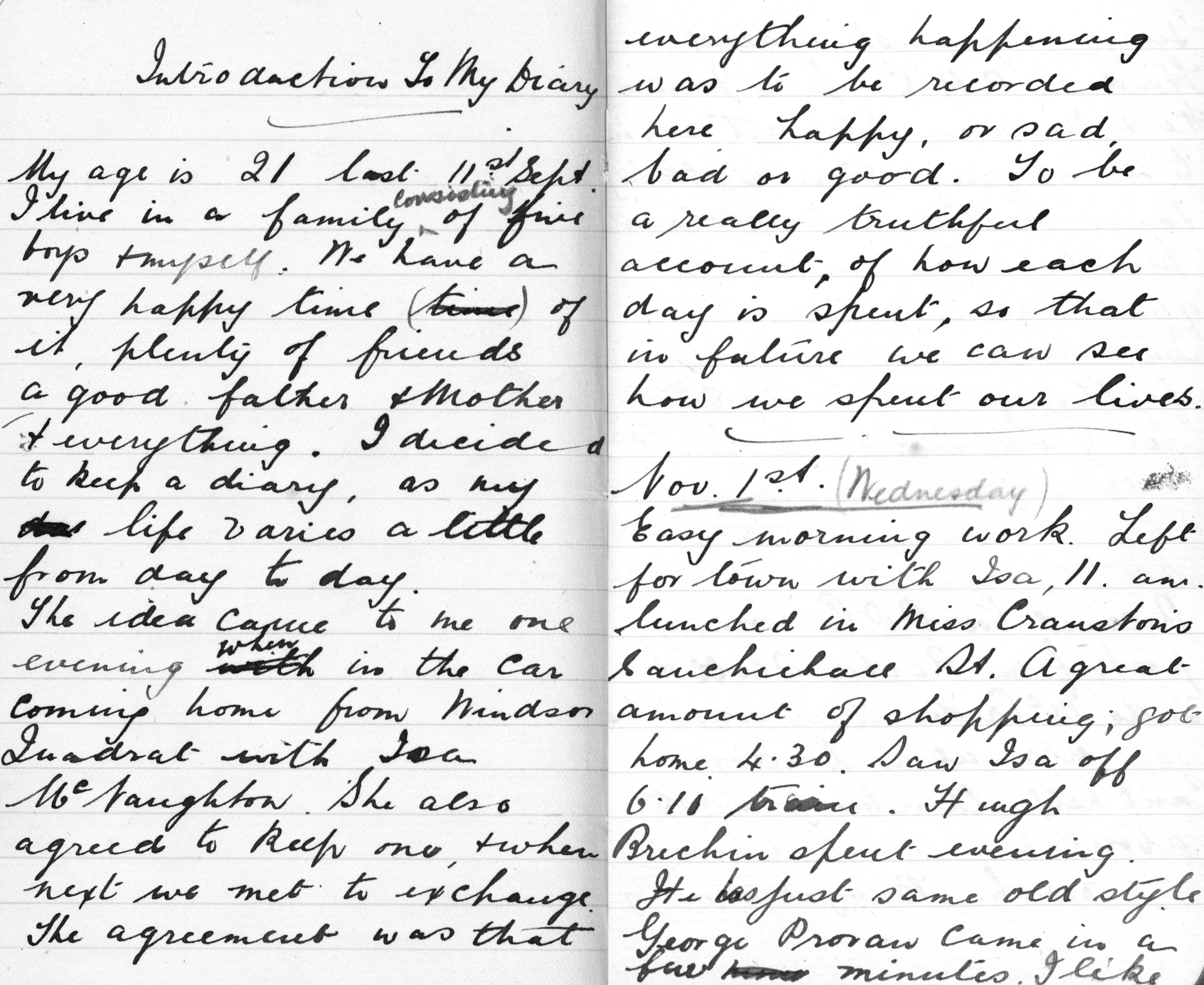
Some family diaries and notebooks found in an attic gave me the original prompt for ‘Ships that Pass’. Mary McNicol, the daughter of a Glasgow wine and spirits merchant, wrote a diary for three months in 1905. She had intended to write it for longer, but the prophesy of a friend that she would not stick to it turned out to be true. The little that we have is fascinating, however, giving an insight into leisured family life in Edwardian Glasgow at the height of the British Empire, a time when women were also on the cusp of liberation.

DoubleDiary

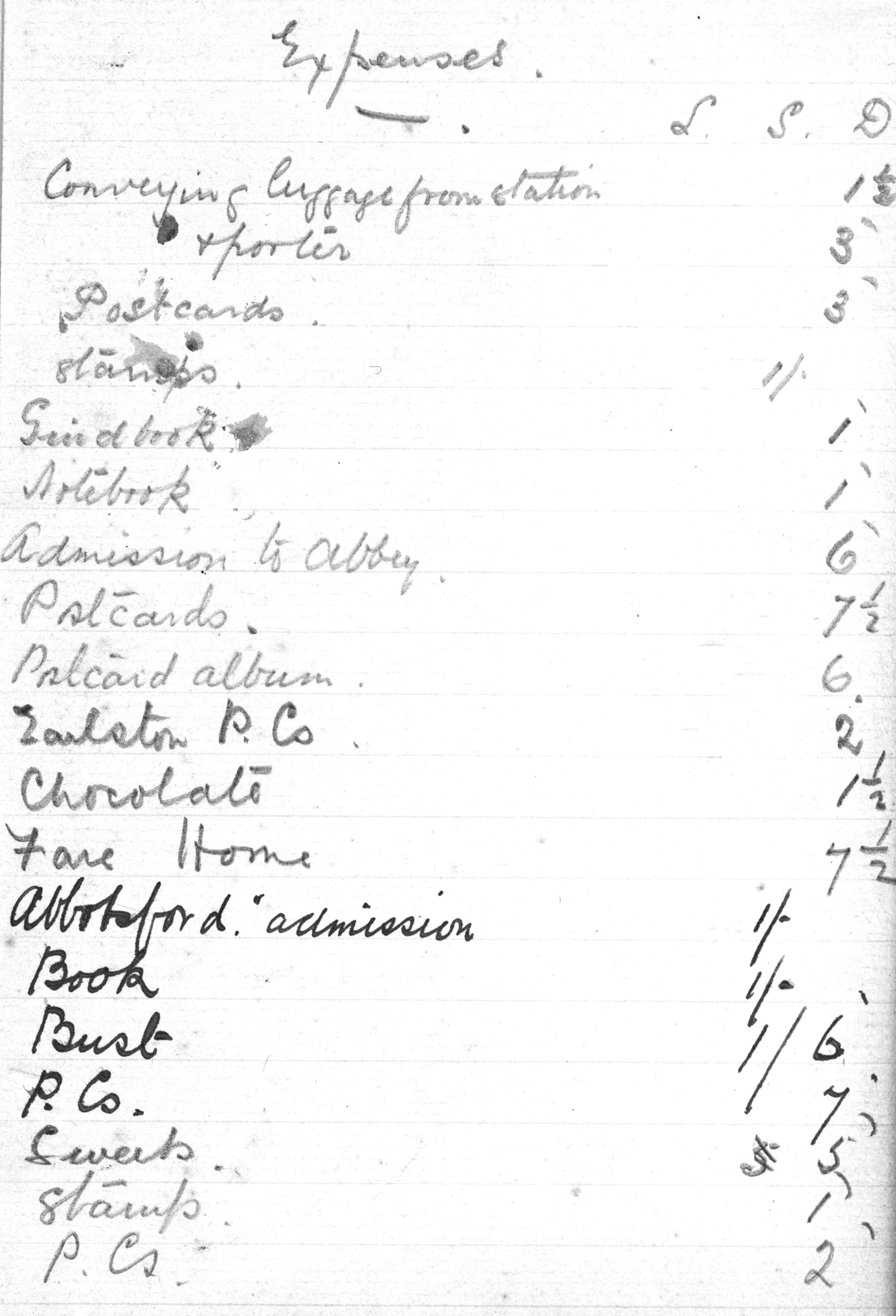
My source material gave me the names of many of the characters in the story I was to write, as well as detail about everyday life – Mary’s dreaded Sunday teaching at the Mission, meeting of friends at Miss Cranston’s Ladies’ Tea Rooms, Mary’s friend Isa and her gift of a lucky farthing.  And then there is Mama and her darning, the maid who leaves to get married, the regular delivery of postcards with messages from friends, the social evenings at home and Mary’s singing lessons.  However, the diaries did not give me a plot.  How was I to proceed?  The diaries gave an underlying hint of dissatisfaction on Mary’s part with a life of domesticity.  One notebook contained a holiday diary about a stay in Melrose where Mary met some Americans who ‘hustled’ and were keen to see all the sights. They sounded so modern that I decided to build them into my story, along with one or two facts that I knew about Mary’s subsequent life. The Americans bring the liberated views which Mary seeks in her desire to escape deep-seated Victorian values and Church traditions. It was here that I also found Mrs McNab of the Station Hotel, who suggests a motor car ride to Dryburgh Abbey.

SaturdayDiary

BordersExpenses

A key to the development of the plot was using a list of the wedding presents which Mary received.  They gave such an insight into the very domestic life of ladies of this era that I could not hesitate to use them!  But what didn’t appear in the diaries were events later in Mary’s life; events connected with her first husband, Andrew.  This aspect of the story was based on recollections of my mother-in-law, and a few photographs found in the same box as the diaries.  That background was transposed in time to give an extra dimension and poignancy to the tale.

MarriageListAs part of my research, I also visited Mary’s house in Craigpark, Dennistoun, a red sandstone end-terrace house, now divided into flats and bedsits.

DennistounHouse

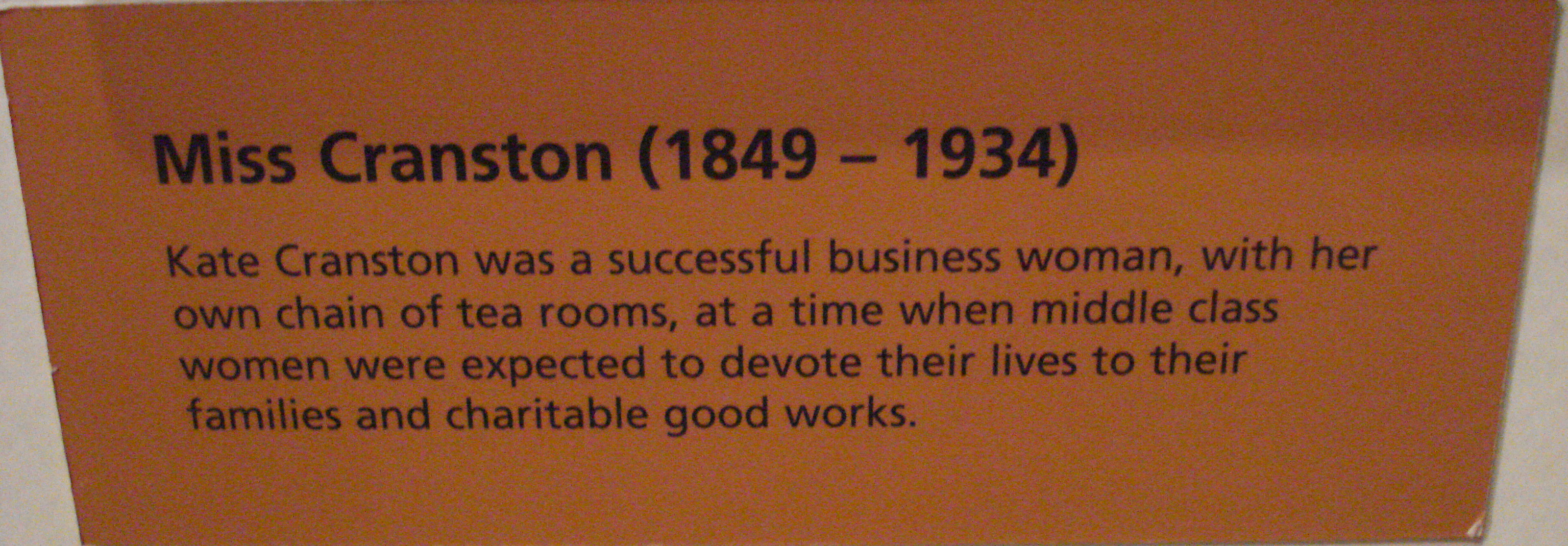
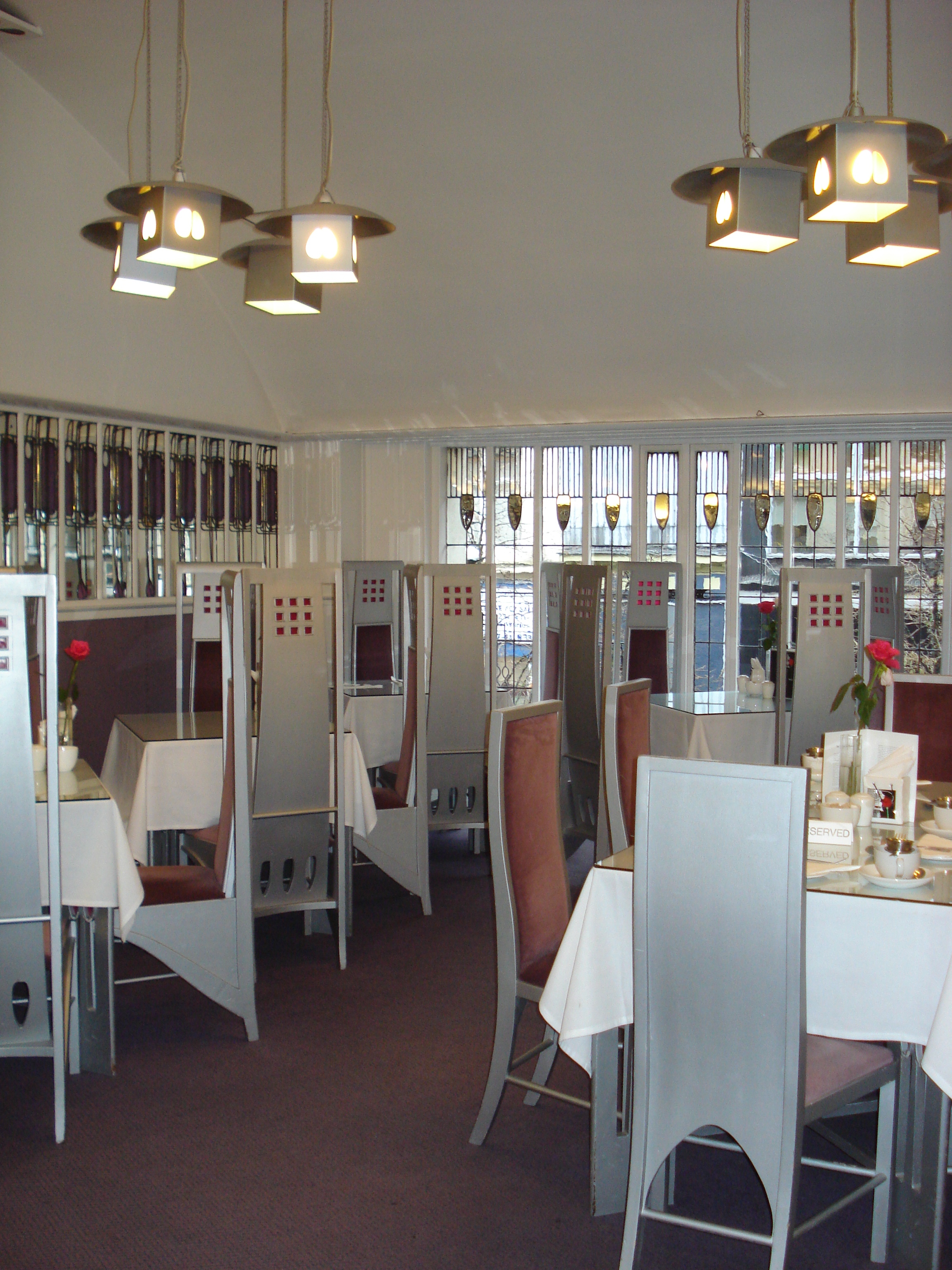
You can still visit the Willow Tearooms in Sauchiehall Street (formerly Miss Cranston’s) and admire Charles Rennie Mackintosh’s De-Luxe Room with its distinctive high-back chairs, where I set some parts of my story.

miss-cranston willow-tearooms

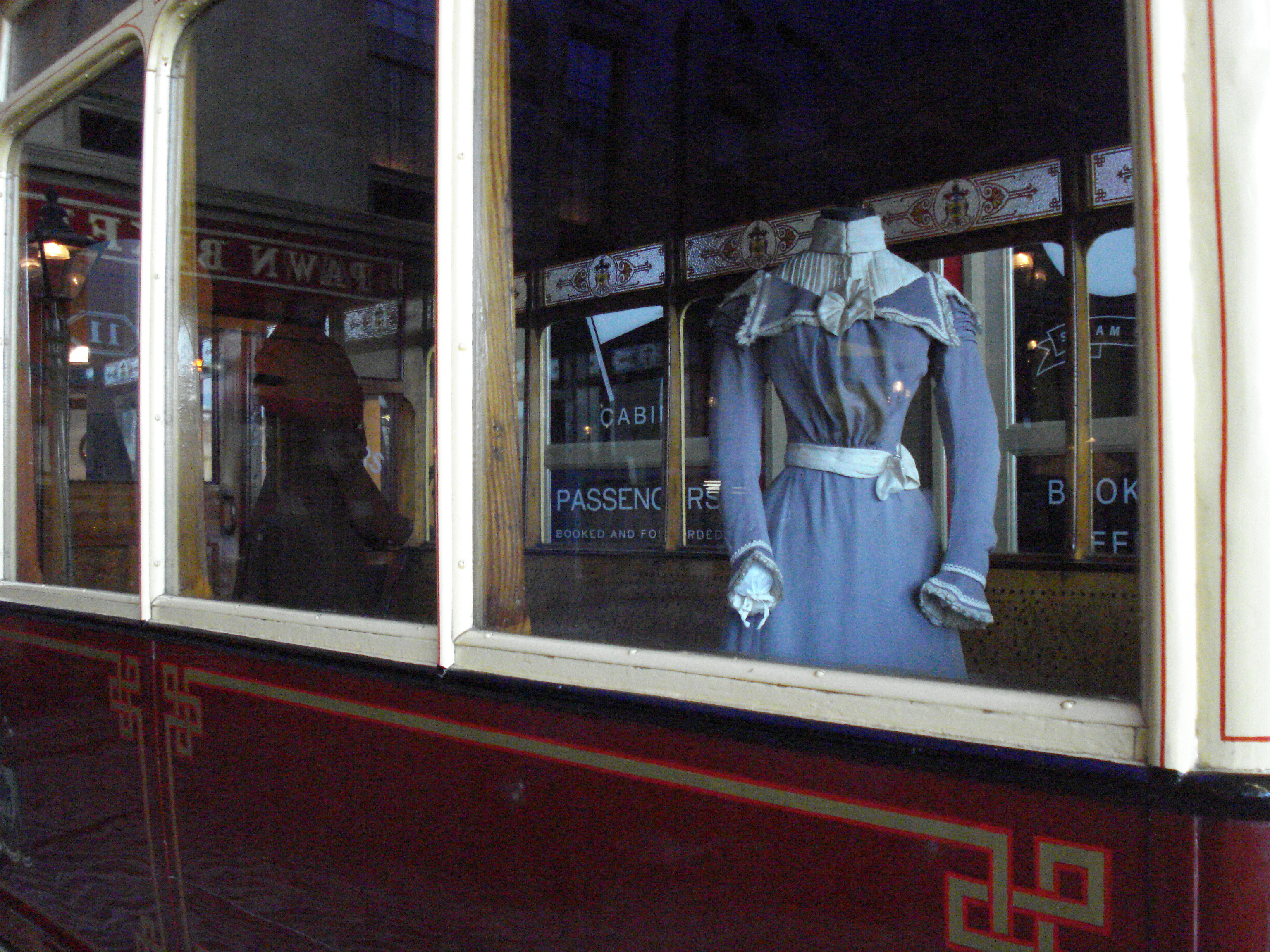
I also enjoyed some research at the Glasgow museums, particularly the Riverside Museum with its trams (that Mary referred to as ‘Cars’ in her diaries) and street reconstruction.

tram tram2

‘Ships that Pass’ was originally a radio play written as part of my Open University course in Creative Writing. I had approached it in this way so that I could get a feel for the voices and sounds of the era and was interested in what I could achieve through speech alone.

When I rewrote it as a novella, I added, among other things, a framework story with Mary’s son which I hoped would give my story perspective and the sense of unearthing discoveries.

Those notebooks have come a long way, and I hope they enjoy their outing in Germany!


18 July 2019

18 Thursday Jul 2019

Posted by Iain C in Writing News

≈ 3 Comments

An update on Christine’s Post from last November:

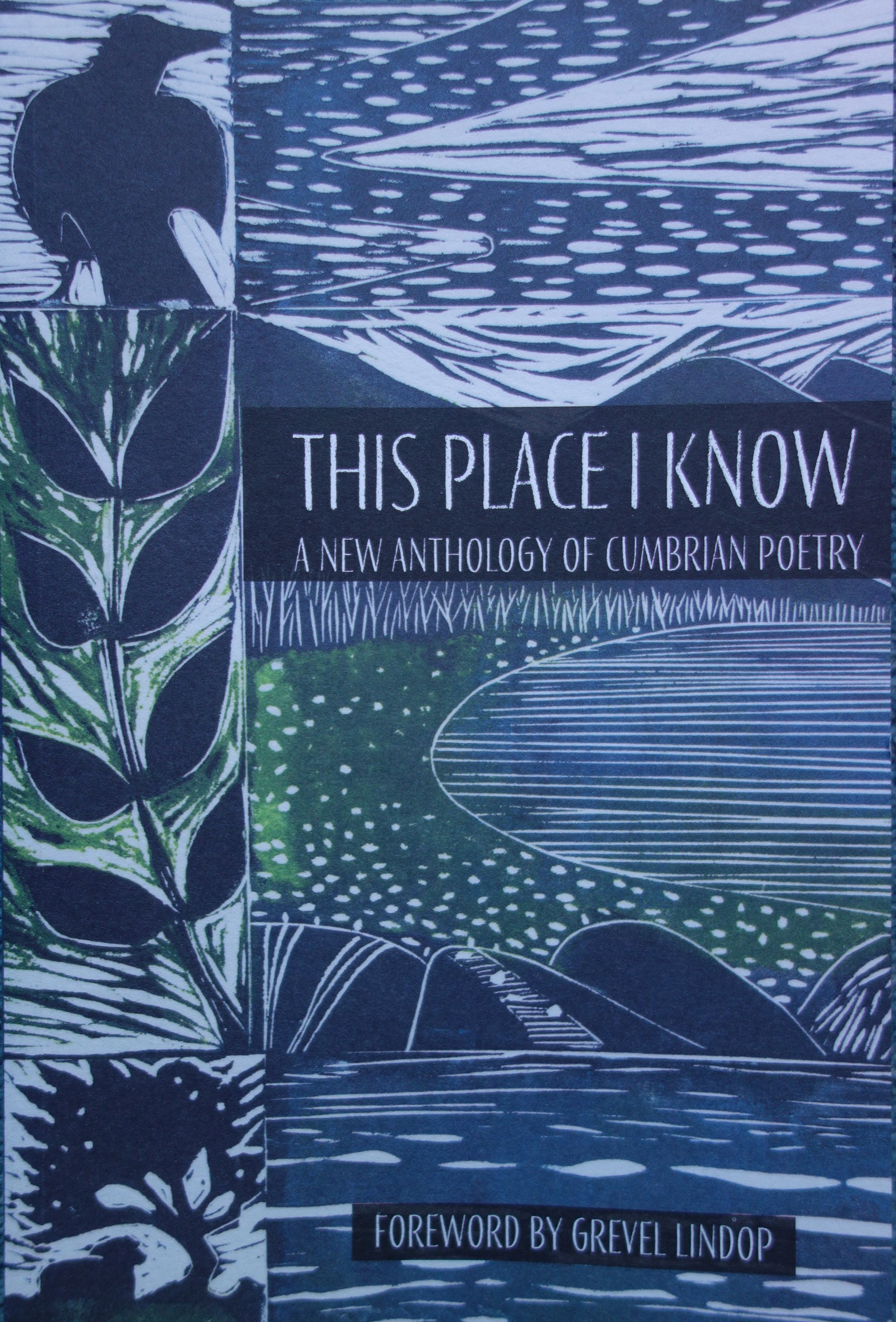
The Anthology of work from 92 Lakeland Poets, THIS PLACE I KNOW, won first prize in the award for poetry and literature at the Lakeland Book of the Year awards, and it was also a very close runner up for the Book of the Year. Hunter Davies said some very complimentary things about the anthology, commenting on the quality and range of poetry and the professionalism of the publication. He recommended it as the ideal holiday read this summer!

Iain C

This Place I Know – knitting a poem

22 Thursday Nov 2018

Posted by Christine Cochrane in Blogging on, Writing News

≈ 2 Comments

Tags

Cumbrian Poetry, Handstand Press, Kendal Mountain Literature Festival, This Place I Know

I’ve had a quiet year.  This was a conscious choice, as my cancer treatment and management have nudged far more than I would like into my diary space, and I took a retreat to really enjoy the process of writing poetry for my MA in Creative Writing with the Open University.  It provided the most wonderful escape from the world of hospitals.  Now it’s beginning to bear fruit.  I’ve submitted my final portfolio for the MA (awaiting results in December!) and am hoping that this will become a published collection of poems in early 2019.


In the meantime I have also had poems selected for Speakeasy Magazine and a new anthology of Cumbrian Poetry, This Place I Know published by Liz Nuttall at Handstand Press in Dent, and edited by Liz, Kerry Darbishire and Kim Moore.  There have been several launch events, and I was able to attend the one at the Kendal Mountain Literature Festival on Saturday 17th November.  And what a wonderful event it was, with varied readings from poets new and well known and some interesting questions and discussion points including ‘What makes a Cumbrian poet?’.  There are certainly a lot of us – 92 in the anthology, and many more round and about.  It’s a good county to be writing poetry in with lots of events such as the recent Kendal Poetry Festival (September 2018) and many different writing groups on the go.


I feel a bit lucky to be included, as I’m not quite sure if I deserve the label ‘Cumbrian poet’.  I have lived and worked here for 37 years and have walked almost every fell top and every valley, and I love every aspect of it.  I feel privileged to live here.  And yet my roots are in Scotland, and that is where I return, and where many of my poems are set.  Looking through my notebook of poetry drafts, I found several that captured Cumbria in some way, and I decided to develop a poem scribbled in the cafe at Sizergh Castle.  This is a special place to me; over my three years of living with ovarian cancer, Iain and I have come here to ‘centre ourselves’.  The coffee is good, the scones are the best in the area, you can look out on some beautiful trees through the changes of the seasons, and there is a huge variety of walks of varying length which have helped me maintain my fitness during some of the tougher phases.  Sometimes my walks are long, sometimes they are short.  But I can gain some height, look out at the Lakeland Fells from Helsington, for example, and feel good about myself.


If you ever go to the National Trust’s Sizergh Castle Cafe on Fridays, you’ll see an enthusiastic ‘knit and natter’ group.  They became the focus of my poem.  I wondered what the women (because it is exclusively women!) talked about.  As I wrote, I became aware that poetry is really very like knitting – we cast on, cast off, stitch together, make patterns and shapes.  There is rhythm to both poetry and knitting, and a sense of something handed down through generations.  A few years ago my mother-in-law, who is now approaching her 103rd birthday, gave me a Vogue Knitting magazine ‘in case I might like to try some of the patterns’.  I think it was bought when she moved to Kendal in the late 1940s.


VogueKnittingCover2

I didn’t try any of the patterns, but I entered a different and exclusively female world where women with the trimmest of waists posed in front of large country houses modelling dolman cardigans, two-tone flecks, giant cables and diamond designs.  There are even patterns for a ‘blouse with box pleats’ , ‘evening wraps’, ‘golliwog twinsets’ and of course ‘sturdy knitwear for men’.  I am old enough to have been a knitter – my mother was, and I knitted too in my teens and early twenties.  And there was that rite of passage when we knitted a pullover for the first man in our lives – I remember that mine came out too big, and I was dedicated enough to rip it all down and start again.  He wore it for years!


3ads_2
My poem in ‘This Place I Know’, entitled ‘In Over Through Off’ explores the whole notion of ‘knit and natter’ in this lovely place, and knits in some ‘found poetry’ from the musical language of the Vogue Knitting advertisements.


The editors have knitted together a fantastic anthology.  This Place I Know is available from bookshops or can be ordered online   A great Christmas present for those who love the Lakes.


And with that I’ll cast off for today. But there might be more poems coming about knitting.  No actual knitting though ….

The Poetry Cure

12 Saturday Aug 2017

Posted by Christine Cochrane in Blogging on, Cancer challenge, Writing News

≈ 10 Comments

Tags

Anthony Wilson, Jo Shapcott, Julia Darling, Of Mutability, Open University, Open University MA Creative Writing A802, ovarian cancer, Penny Brohn UK, Riddance, The Poetry Cure, Wayne Holloway-Smith

July was a month of mixed emotions. I learned that I had passed the first year of my MA in Creative Writing with merit.  I also learned that my ovarian cancer had bubbled up again in some small peritoneal deposits, necessitating the start of a new course of chemotherapy, which I began on 20th July.  All things considered, I have enjoyed an amazing quality of life since my diagnosis in November 2015, which was followed by 6 cycles of chemotherapy and a further year on the maintenance drug Avastin; I went from not being able to climb the stairs in November 2015 to skiing on the Kitzsteinhorn glacier, Kaprun (3000 metres) in January 2017.  Since completing my Avastin in February, I have been on ‘watch and wait’, having been told that recurrence is almost a certainty with my type and stage of cancer, but that they could keep retreating me again if required. The CT scanner found it in June, although I had no symptoms.   On with the ‘treats’, then…
 
I suppose this officially puts me into ‘battling’ territory.  Those who know me also know that I hate this term.  The phrase ‘lost their battle with cancer’ is trotted out unthinkingly; I don’t like to think of ever losing.  I am living with cancer, as are many people, just getting on with the things you enjoy and maximising the moments when you feel you will live forever.  It is the same as for any chronic condition, like heart disease or diabetes; you carry a cloud with you, but you live for when it floats off.  There are times when it’s the first thing you remember when you wake up, and there are times when you are so distracted by nature, music or any kind of creative work that it disappears completely. In the words of Winnie the Pooh, ‘every little cloud always sings aloud’, and my singing and harp playing have offered me these special moments, as have the many hours spent with friends and family, my local walks and walking holidays and a perfect skiing trip to Zell am See that I never thought I’d have. I’ve played the harp in the grounds of Levens Hall, I’ve walked Scottish beaches and posed with Robert Burns at the Birks of Aberfeldy.  And I’ve climbed my 200th Wainwright top in the Lake District, the wonderfully named Great Cockup.
The first course of treatment had enabled me to reclaim my life, and news of the recurrence meant some grieving had to happen. So far, the chemotherapy has been manageable, and I won’t lose my hair this time, but it has been a shock to go to it from feeling well, and there are some days when I feel very fatigued; at times it seems as if I am operating at altitude. Yesterday I felt slightly drunk in charge of a shopping trolley.  I don’t feel ill, and on many days I can operate as normal, go out walking and meet the friends who cheer me up.  But there is a need for more rest and quiet time.  Everyone says I am very positive, but inevitably dark thoughts also have to be processed.
 
The cancer treatment world is very surreal.  I have seen the very best of the NHS, have chatted to many ‘brave’ and ‘positive’ patients and have recognised how much I owe to the chemotherapy drugs, but I can never get over the fact that this clear liquid dripping into my veins, which comes with so many health warnings and arrives personalised for me in a yellow carrier labelled ‘cytocoxic’, is the thing that is needed to ‘help me to live well’ – this is the slogan on my chemotherapy record booklet, and it’s a good one (much better than battling!).  Even after 25 visits to the oncology unit, I am still pinching myself wondering if it’s all a dream.  From talking to other patients, we’re all like this. It’s not me in here, is it?
 
Good as the NHS treatment has been, I realised at an early stage that I needed more than cytotoxic drugs to get me through it. In July 2016 I attended a course run by the charity Penny Brohn UK ‘Living with the impact of cancer’ – their emphasis on healthy eating, exercise, meditation, mindfulness and taking control of your own health and wellbeing perfectly complemented the conventional treatment I received.  Once again, I met many inspirational people and enjoyed the exchange of thoughts on how we deal with a new way of life that has been forced on us. The course principles all involve very simple things – and indeed turning attention to how you can live better and more mindfully is common sense, whether you have cancer or not.  
 
So what of my writing?  In the past year it has been very much about writing for myself and not about sharing and tweeting that I’ve written something.  It’s been part of my mental processing to be a bit more private.  Also, if I publish work here, I can’t enter it for competitions. When I opted to start the Open University’s new MA in Creative Writing in October 2016 (module A802), I decided to pick poetry as my first genre with fiction second, as I felt I had more to learn about poetry and that it would offer me greater variety.  Also, I have met poets locally at workshops and readings, and it is more sociable than trying to churn out a plot and redraft a novel!  The OU course is all distance-learning, and work is shared with your tutor group via an online forum.  Our tutor, Wayne Holloway-Smith, dropped in from time to time with mainly encouraging comments and some remarks to make us think, and gave us very full feedback on our assignments.  We all started off writing about waves breaking on the shore and sunrises, but his key comment was ‘Why should the reader be interested?’.  I have carried that thought with me all through this year, and if you are still reading this blog post then I’ve succeeded in addressing this question.  
 
Of course, it’s a disadvantage that you never meet the people on the course or know what their voices sound like, but on the other hand you can choose just how much of yourself to reveal, and the drip-feed of information about people and their backgrounds that came out in the poetry generated throughout our year together was fascinating.  We all got quite good at giving each other feedback. Our ages ranged from 20+ to 60+, with more, I have to say, in the older category, full of life experience and inevitably touched by sadness as well as joy.  I did not set out with the purpose of writing about my cancer, and indeed I enjoyed keeping it quiet in the first term.  After Christmas we encountered Confessional Poetry, and it was finally time for me to write about the chemotherapy room.  The readers were interested; I had followed another tutor tip and exposed vulnerability.  The news was out and, in the end, my poetry sequence for my end of year assignment reflected on illness and mortality.  I was inspired by Jo Shapcott’s collection ‘Of Mutability’ and the way she described her experience of cancer in a very understated way, without even mentioning the word.  The title of my sequence ‘The Pavement Rippled Under My Shoes’ is a quotation from her poem ‘La Serenessima’.  Since then, I have discovered other poets who ‘write their cancer’ and have been reading Anthony Wilson’s wonderful collection ‘Riddance’ about his diagnosis and treatment for lymphoma. He writes here about Jo Shapcott’s ‘Of Mutability’ https://anthonywilsonpoetry.com/2011/03/02/book-review-of-mutability-by-jo-shapcott-2/
 
Recently, I picked up an anthology ‘The Poetry Cure’ edited by Julia Darling and Cynthia Fuller, which I took into the chemo room last week. Julia Darling, a poet and Fellow in Literature and Health at the University of Newcastle upon Tyne, was involved in many projects seeking to improve communication between doctors and patients.  She died from cancer in 2005 shortly after completing her work on this book, which she wanted to be available in hospital waiting rooms.  She writes in her introduction:
‘I work with doctors and patients, and run workshops for the growing numbers of people who are interested in the healing powers of poetry.  I got involved in this kind of work through my own experience.  I have advanced breast cancer, and poetry is what keeps me afloat.  Without writing and reading poems my journey through chemotherapy and radiotherapy and the general ups and downs of illness would have been unthinkable ….  I think one of the hardest things about being unwell is feeling disempowered and out of control.  Writing poetry can make you feel in charge again.’
 
I had better sign up for the second year of the MA course.  But before I do, I conclude with two of my poems from ‘The Pavement Rippled Under My Shoes’.

Sword Dance 1


X marked the spot in the hall behind

the Burnett Arms, where our class danced

on Thursdays over crossed swords

to bagpipes skirling Ghillie Callum,


a seventy-eight on the Dansette.

The turntable turned, and so did we,

twenty kilts fanning out like accordions

swung up like tartan wings behind us


and our black laced pumps

pranced plump pas de basque

up and down, round and round,

always widdershins.


Whirling high with bonny smiles

we had no thought of edges

sharp as Sheffield knives

under our feet.

Later I learned

 that to touch

the blades

meant

mis

for

tune


Sword Dance 2


Nurses

 in flat, black shoes

and sky-blue suits

dispense clear liquids that drip, drip

from innocent plastic bags, incinerated after use.

Do not talk to me of battles.

Let me dance through the door with nothing

but numbness of neuropathy

in my toes,

hear

birdsong

tingle

in

bare

branches.

Ways of meeting

16 Thursday Feb 2017

Posted by Christine Cochrane in Blogging on, Writing News

≈ 2 Comments

Tags

Edition Narrenflug, Gabriele Haefs, Geraldine Green, Karin Braun, OU Creative Writing MA, Vierertreffen, Write on the Farm

Where did that blog go?  Things have been looking a bit quiet on Harping On, as I’ve been busy with the OU’s new MA in Creative Writing.  Writing about writing has therefore taken a back seat.  Along with that has come a little bit of a desire to do less in the way of social media – it’s good to create a bit of space sometimes.

In the meantime, the German version of my story ‘Ships that Pass’ has been published in the anthology ‘Vierertreffen’, which means a Meeting of Four.  I haven’t met the other three authors in real life, but perhaps I will some day.  Two of us are from Scotland, two of us are from Ireland – hello to Brian McNeill, Rita Kelly and Micheál Ó Conghaile – and many thanks to Karin Braun and Gabriele Haefs for compiling this volume of four ‘long short stories’.

http://edition-narrenflug.com/vierertreffen-schottland-irland-erzaehlungen/

I’m half way through the first year of the MA course, where I’m studying Poetry as my primary genre and Fiction as my secondary.  This is the opposite way round from what I originally intended – I just thought it would be more interesting to develop the poetry side, as I felt I had a lot to learn about doing it better.  So far, the course material has been stimulating and people are contributing some interesting stuff in the online tutor group.   I’ve been challenged, pushed in a few new directions and received some home truths about improving my focus.  The downside is that it is all online – you don’t meet the tutor or participants, and there is an awful lot of screen work and clicking, which has given me some RSI problems … another reason for being a bit quiet on the blog.

In the pursuit of more poetry-sharing with real people in the real world, I’ll be co-leading a poetry workshop with local poet Geraldine Green on 25th February.  This workshop is one in Geraldine’s ‘Write on the Farm’ series which I’ve been attending for a year or two.  When someone discovered I had a harp they wanted me to bring it to the party, and this workshop is the result!  We’ll be looking at the origins of the instrument, talking about lyric poetry and writing in response to harp music.  Time in the outdoors is always a part of Geraldine’s workshop, as is some quiet writing time in the afternoon.  It is already fully booked!

https://geraldinegreensaltroad.blogspot.co.uk/2016/09/write-on-farm-dates-for-2017.html

The lay of the land

20 Tuesday Sep 2016

Posted by Christine Cochrane in Blogging on, Musical notes, Writing News

≈ 2 Comments

Tags

Geraldine Green, Harps North West, Jane Moss-Luffrum, Karen Marshalsay, Open University MA Creative Writing

I’ve needed a summer break – a chance to reflect on the ups and down of the last year since my cancer diagnosis, and to consider new projects.  I feel very well and apparently look great on my treatment, but I’m constantly monitored and checked, which inevitably makes me edgy. However, I’ve worked out the best way forward is to Keep Calm and Be Normal.  Going out and doing stuff with others and having a project or two helps me forget for increasingly long periods what happened.  Onwards!

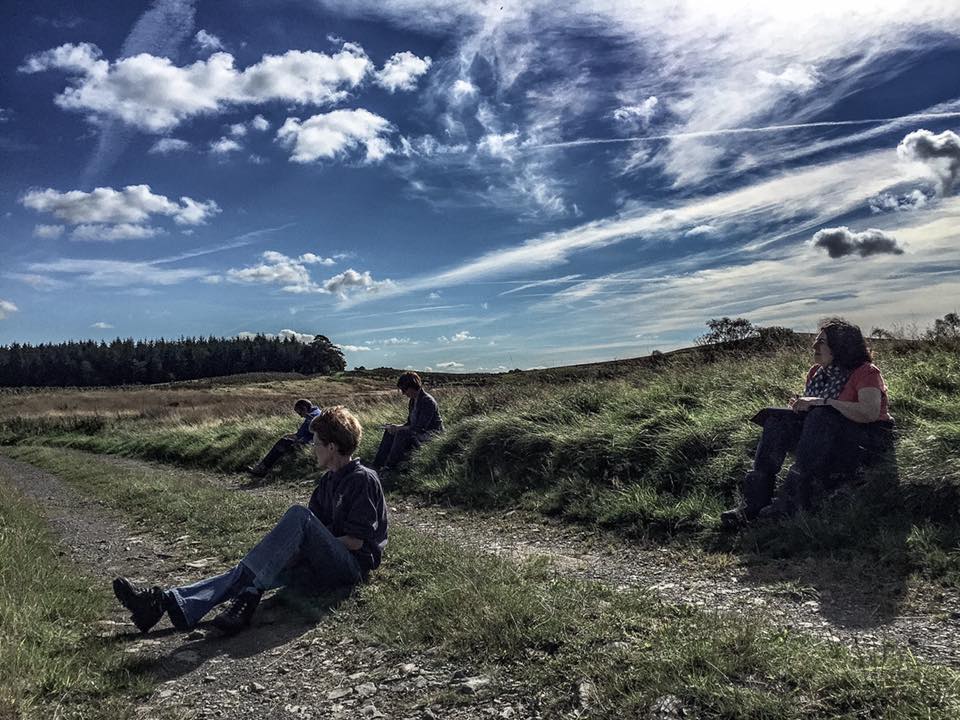
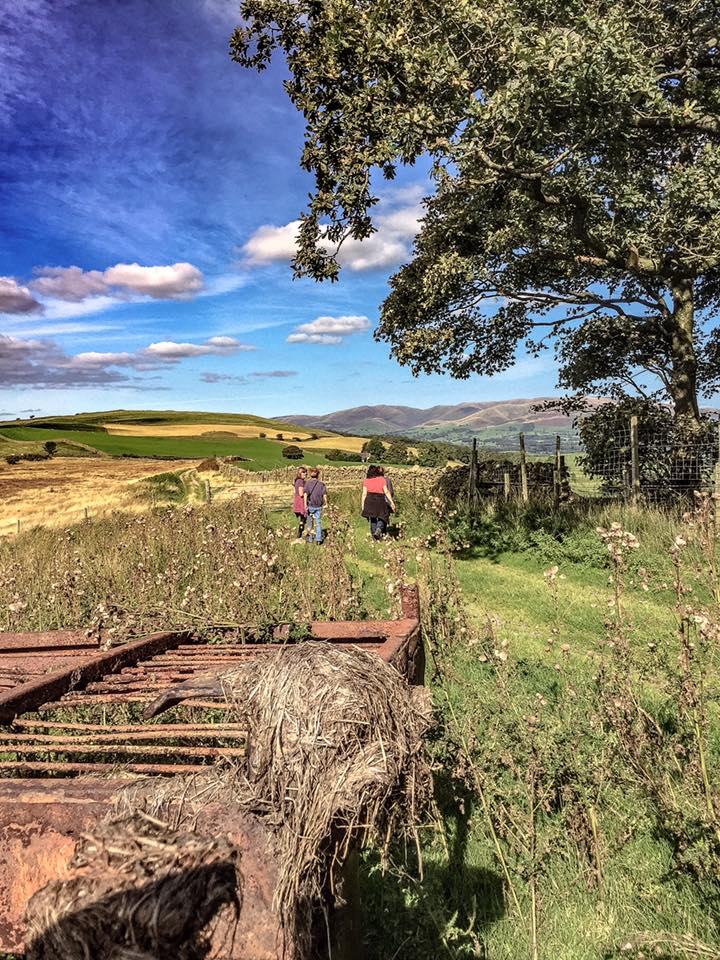
Sometimes a special time comes along and all your interests and ideas converge, and this past weekend has been just like that.  Geraldine Green, Writer in Residence at Brantwood, Coniston, who also runs writers’ workshops at a local Cumbrian farmhouse, says it is ‘full moon magic’.  On the day after the full moon, the sun shone for us  for the above the Lune valley, lighting up this year’s particularly prolific rowan berries and plump blackberries in the hedgerows.

rowan

photo by Jane Moss-Luffrum

Among other things, we wrote to prompts on memories and fruit using Marsha de la O’s ‘UnderThe Lemon Tree’.  In the afternoon we wandered out with ‘The Earth is a Living thing’ by Lucille Clifton; the path took us on to the hills overlooking the Lune Valley to pause, contemplate and write.

writing

Photo by Jane Moss-Luffrum

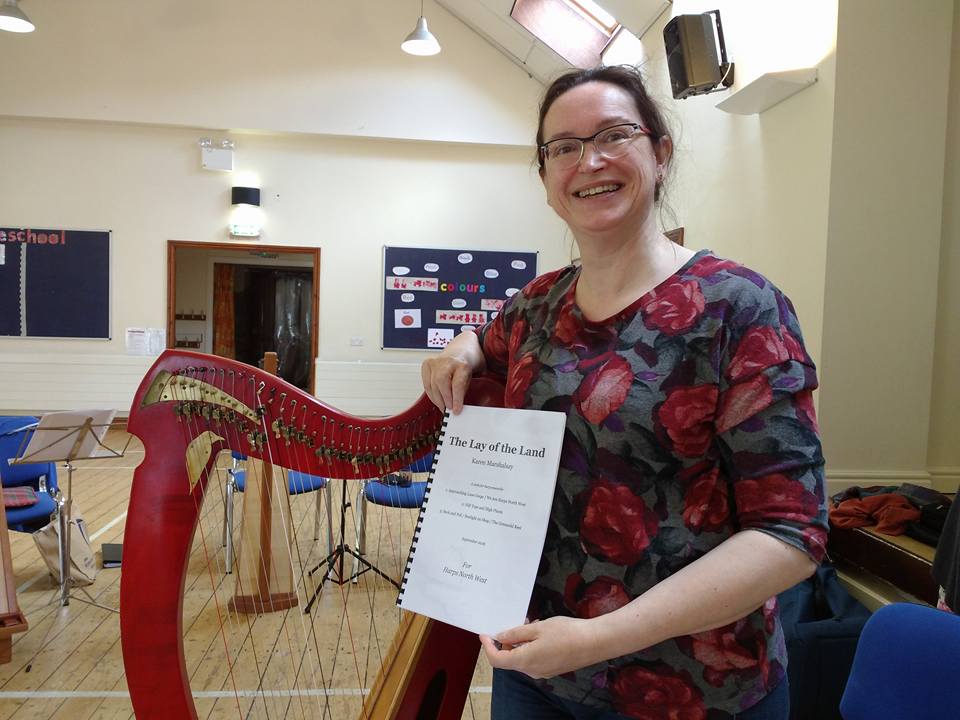
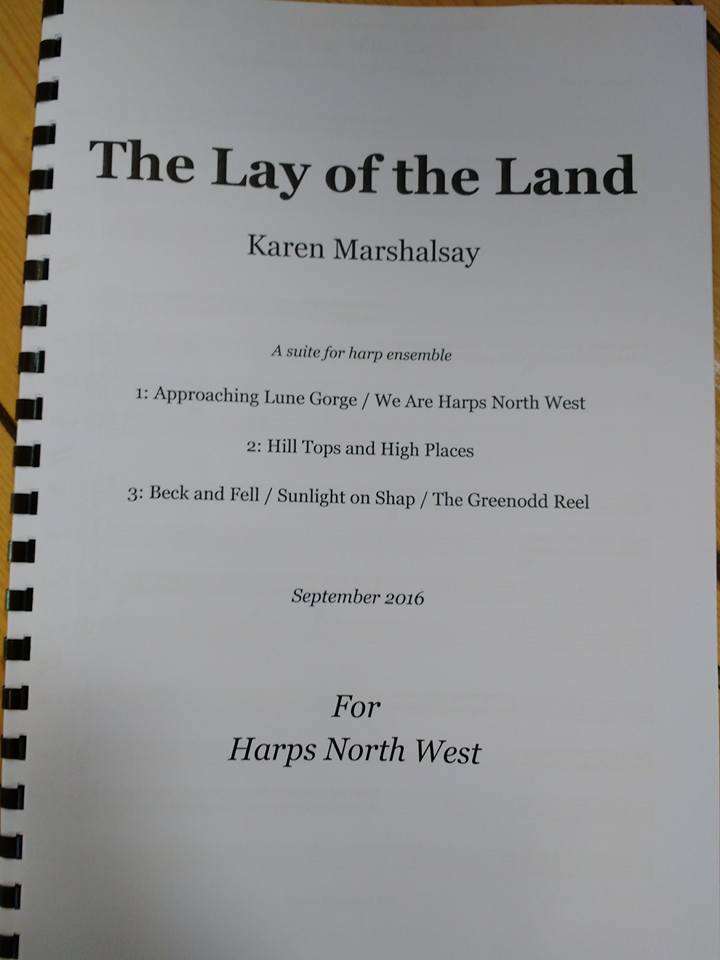
There were more riches for me the following day at a Harps North West workshop.  Over the past year our composer in residence, Karen Marshalsay, has been working with us on a suite of music specially written for Harps North West – all ability levels will be able to join in, and the idea is that the music will reflect who we are and the landscape in which we live.  We have had two workshops in February and June where Karen has tried out her ideas for melodies and taught us some interesting techniques such as bee’s plaits, finger plaits, shoogly finger and gurgly two handed variations.  We now have the finished piece.

karenIt has been fascinating to share in the creative process over a long period and to see that it is very much like writing a poem – the ideas and themes, the refrains, the motifs.  And then there’s the putting away of a work and letting it bubble and marinate, the taking it out and reshaping until it finds its final form.  Karen’s finished suite is entitled ‘The lay of the land’ and her opening section ‘Approaching Lune Gorge’ is about that landscape in which the poets walked on Saturday.

walking

Photo by Jane Moss-Luffrum

Karen said that getting to know the landscape over the year and in different seasons helped her round the finished piece.

scoreThe lay of the land for me is somewhat different from what it was a year ago.  During the year of my illness and recovery, copies of ‘Shifting Sands’, my book of short stories, have sold well, and I’d like to thank everyone for all the positive comments I’ve received.  I’m delighted to say you can now even buy it on the shops on CalMac Ferries, so check it out over a CalMac cooked breakfast the next time you are sailing to the Hebrides.

janetshiftingsandsBut now it’s time for a new challenge.  I’ve been offered a place on the Open University’s new MA in Creative Writing, and I’m excited to be starting soon.  Initially I thought I would major in fiction, but lately I’ve been pulled in more by poetry and its connection with music, and this past weekend has underlined that choosing poetry as my main genre will be my way forward.  I have some new ideas, and among other things I will be doing a workshop with Geraldine in February on connections between harp and poetry.

Thanks go to Geraldine and all who contributed to the poetry day, particularly Jane Moss-Luffrum for letting me use her wonderful photographs on the blog.  Thanks also go to Karen and all at Harps North West for all the fine music we make together.

layers

Poets in the landscape – Jane Moss-Luffrum

Targets and teamwork: how to complete a daily writing challenge

06 Monday Jun 2016

Posted by Christine Cochrane in NaPoWriMo 30 Poems in 30 Days April 2016, Writing News

≈ 2 Comments

Tags

Follow the Brush, NaPoWriMo, Write-Track

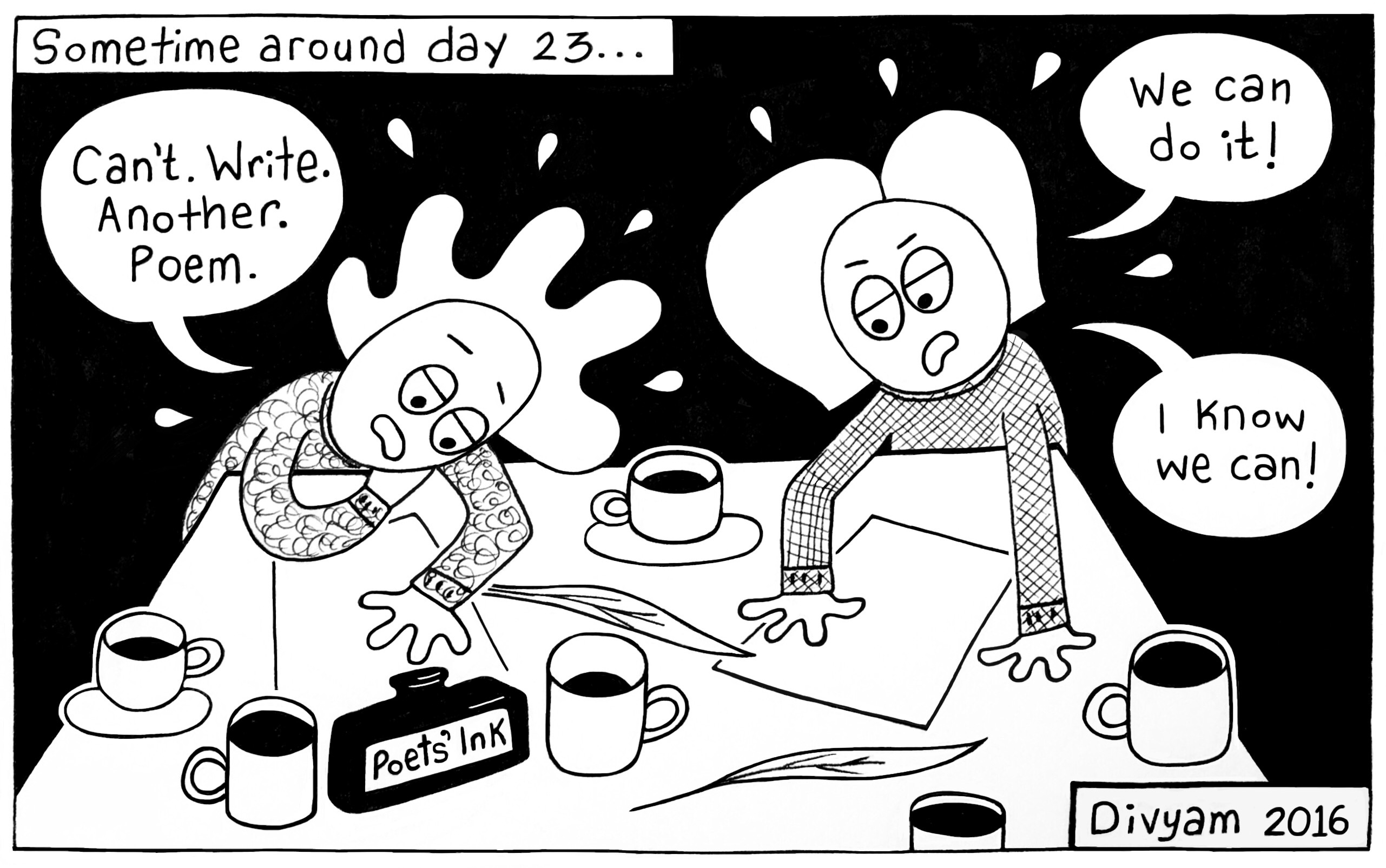
Following on from our teamwork on the great NaPoWriMo challenge in April, Divyam and I were invited to write a blog for Bec Evans at Write Track on Targets and Teamwork. Follow the links and enjoy Divyam’s wonderful cartoons!

Divyam's avatarfollow the brush

NaPoWriMo 2

I am THRILLED to be featured on the Write-Track blog, together with my writing buddy, the fabulous Christine Cochrane! Join us for a conversation about taking part in this year’s NaPoWriMo, including the challenges we faced and how we supported each other along the way. Plus: CARTOONS!

What keeps us going as writers? Staring alone at the blank page doesn’t always work; sometimes it’s about targets and teamwork. Christine Cochrane and Divyam Chaya Bernstein are two writers who recently completed the daily writing challenge NaPoWriMo. They tell us how they supported each other along the way.

Read the full article here: Targets and teamwork: how to complete a daily writing challenge

View original post

A review from Germany

22 Friday Apr 2016

Posted by Christine Cochrane in Writing News

≈ 4 Comments

Tags

Christine Vogeley, Edition Narrenflug, Gabriele Haefs, Lumphanan Press, Shifting Sands: Tales of Transience and Transformation

It’s been five months since I published ‘Shifting Sands’ and I’m delighted to say sales have gone well, both for the book (available online from Lumphanan Press (http://lumphananpress.co.uk/product/shifting-sands/) and for the ebook (available on Amazon Kindle http://www.amazon.co.uk/Shifting-Sands-Tales-Transience-Transformation-ebook/dp/B0187MJUL2/ref=sr_1_1?ie=UTF8&qid=1449398674&sr=8-1&keywords=shifting+sands+christine+cochrane).  There are some great, informative reviews up there on Amazon, so thanks to all who have read and commented!  If you’re travelling in the Scottish Highlands and Islands, the book is also available at

Aros Centre, Portree, Skye

Carmina Gadelica, Portree, Skye

MacGillivray’s, Balivanich, Benbecula

Kildonan Museum, South Uist

Ullapool Bookshop

and more to come!

It’s been a turbulent five months for me as I have been going through cancer treatment, but I’m coming out the other side now and enjoying the spring sunshine as well as the daily prompts for NaPoWriMo 2016 which I’ve been posting on my blog throughout April.  Thanks go to my husband Iain for dealing with a lot of the book administration when I wasn’t up to it!

Thanks also go to all the people who have kept me cheered with cards, flowers and chocolates.  The parcels are still coming!  Yesterday brought this delightful selection from Gabriele Haefs in Germany.

DSC00509_crI’m delighted to receive this signed copy of Christine Vogeley’s ‘Sternschnuppensommer’, some chocolate and the first review of ‘Shifting Sands’ in German, written by Gabriele for Folkmagazin.

And here’s the text of the review and an English translation:

Schottisches Buch: Von Christine Cochrane gibt es bisher eine Geschichte auf Deutsch (in dem Buch ‘Weibsbilder’ der Edition Narrenflug).  Es ist eine Geschichte wie eine schottische Ballade, von einer Frau, die auch Seehundsgestalt hat und die an Land kommt, um Unheil anzurichten. Diese Erzählung ist auch in Christines neuer Sammlung enthalten, die gerade auf Englisch erschienen ist.  Man koennte ja denken, sie schriebe nur solche märchenhafte Dinge, aber einige Erzählungen sind auch im Hier und Jetzt verwurzelt.  Die Personen halten sich nicht nur auf den Hebriden oder in Glasgow auf.  Auch nach Spanien und sogar nach Schwerin führt sie ihr Weg.  Und immer ist Musik im Spiel – eine alte verwirrte Dame im Altersheim erinnert sich ploetzlich an ein Lied, mit dem sie immer großen Erfolg hatte, eine junge Witwe versucht trotz allen Widerstandes ihrer Familie ein neues Leben als Sängerin anzufangen, ein älteres Ehepaar, das sich vor vielen Jahren in einem Folkclub kennengelernt hat, will den Lebensabend in Spanen verbringen – der Mann packt seine alte Gitarre aus und statt ‘Streets of London’ spielt er nun Flamenco.  Sch schoen und variert sind die Geschichten, und so lange es das Buch noch nicht in deutscher Uebersetzung gibt, empfehlen wir den massenhaften Erwerb der englischen Ausgabe über http://www.lumphananpress.co.uk

Scottish Book:  One of Christine Cochrane’s short stories has appeared in German (in the anthology ‘Weibsbilder’ from Edition Narrenflug).  It’s a story a bit like a Scottish ballad about a ‘selkie’, a seal who takes the form of a woman and who comes on land to create misfortune.  This story appears in Christine’s new collection of short stories which has just come out in English.  You might imagine that she only writes fairy-tales like this one, but the other stories are  firmly rooted in the here and now.  The characters are not just in the Hebrides or Glasgow.  She takes us to Spain and even to Schwerin in Germany.  And music is always there in the background; a confused old lady in a care home suddenly remembers a song that she once sang with great success, a young widow wants a new life as a singer despite the resistance of her family.  And there’s a middle aged couple who retire to Spain; the husband unpacks his old guitar and instead of playing ‘Streets of London’ learns flamenco.  That gives an impression of the nice variety of the stories!  It’s not yet available in German, so we recommend getting the English edition through http://www.lumphananpress.co.uk.

Living with the unexpected

06 Sunday Dec 2015

Posted by Christine Cochrane in Blogging on, Writing News

≈ Leave a comment

Tags

Lumphanan Press, Shifting Sands

In January 2015 I could see the year stretching ahead of me.  I thought of the trips we’d planned to France and the Scottish Islands and the Llangollen Canal, I thought of all my musical activities and my writing, and I wondered if I’d finally get my collection of short stories published.  The good news about the stories is that I did get my act together, and that ‘Shifting Sands: Tales of Transience and Transformation’ is now available to order from http://lumphananpress.co.uk/product/shifting-sands/   And the ebook is available from Amazon http://www.amazon.co.uk/Shifting-Sands-Tales-Transience-Transformation-ebook/dp/B0187MJUL2/ref=sr_1_1?ie=UTF8&qid=1449399217&sr=8-1&keywords=christine+cochrane+shifting+sands

And then something unexpected happened.  Something that wasn’t good.  Something that disrupted everything I took for granted.  ‘You can’t have cancer!’ a friend said.  ‘You’re too young, too healthy, too active!’  But I did.  In October I was diagnosed with ovarian cancer.  This is a cancer that can remain silent for a long time before the symptoms of bloating, tiredness and digestive problems make themselves felt.   I urge any woman to make herself aware of the symptoms, because these are not symptoms that immediately make you think the cells in your ovary might be misbehaving.  I thought that I couldn’t finish my meals because restaurants were serving bigger portions, and that I was slow going uphill just because I was a little bit older – but no, these are symptoms of the illness. You can read all about it on http://www.targetovariancancer.com

So I faced my three biggest fears – hospitals, cancer and chemotherapy.  As with most things, the reality has not been as bad as the anticipation.  I have a fantastic medical team supporting me and the care I have received in hospital has been first class.  I’ve had some dark moments, but I’ve also learned the power of positive thinking, and sometimes the nurses have said just the right thing at the right time to keep me going.  There’s been a bit of humour and a bit of banter, and it’s all helped.  A week ago I had my first round of chemotherapy, and after a few days of tiredness and other symptoms I am finally feeling just a little bit better than I have done for the past two months.  So the magic potions must be working.  After three rounds I will be reviewed for surgery, which could take place at the end of January if all goes well.  And after the surgery there will be three more rounds of chemotherapy.

I now feel surprisingly content, even with Storm Desmond rattling the windows and the rain hammering on the roof.  I am ill, but I have had two months of cherishing my relationships with others, of enjoying people’s visits, emails and Facebook messages, of experiencing great kindness and many offers of help.  I’d like to thank everyone who has been there for me through this difficult time, as well as all those of you who have supported me on the long journey to the publication of the book.

← Older posts

Pages

  • About Christine Cochrane
  • Blogs
  • Home Page
  • Links
  • Publications
  • Reviews

Categories

  • Blogging on
  • Cancer challenge
  • Musical notes
  • NaPoWriMo 30 Poems for April 2015
  • NaPoWriMo 30 Poems in 30 Days April 2016
  • Writing News

Recent Posts

  • School Memories
  • From Glasgow to Germany – Ships that Pass
  • 18 July 2019
  • This Place I Know – knitting a poem
  • The Poetry Cure

Archives

  • August 2024
  • July 2019
  • November 2018
  • August 2017
  • February 2017
  • September 2016
  • June 2016
  • April 2016
  • March 2016
  • February 2016
  • December 2015
  • November 2015
  • October 2015
  • July 2015
  • May 2015
  • April 2015
  • March 2015
  • February 2015
  • January 2015
  • December 2014
  • November 2014
  • October 2014
  • September 2014
  • August 2014
  • July 2014
  • June 2014
  • May 2014
  • March 2014
  • February 2014
  • January 2014
  • December 2013
  • November 2013
  • October 2013
  • September 2013

Meta

  • Create account
  • Log in
  • Entries feed
  • Comments feed
  • WordPress.com

Blog at WordPress.com.

Privacy & Cookies: This site uses cookies. By continuing to use this website, you agree to their use.
To find out more, including how to control cookies, see here: Cookie Policy
  • Subscribe Subscribed
    • Harping On
    • Join 39 other subscribers
    • Already have a WordPress.com account? Log in now.
    • Harping On
    • Subscribe Subscribed
    • Sign up
    • Log in
    • Report this content
    • View site in Reader
    • Manage subscriptions
    • Collapse this bar
 

Loading Comments...